

The cowboy mullet haircut is having a real moment in 2026. It takes the short-front, long-back shape of the classic mullet and gives it a rugged, Western edge: loose texture, natural movement and a lived-in finish that looks right under a hat or without one. If you want a cut that feels bold but still wearable, this guide shows you ten cowboy mullet haircut styles, who they suit and how to keep them looking sharp.
Quick answer: A cowboy mullet haircut is a mullet with shorter, tidier hair on the top and sides and a longer, textured back that falls over the collar. The Western twist is the relaxed, slightly rough finish instead of a polished, sculpted one.
What Makes a Cowboy Mullet Haircut Different?

A standard mullet is often about contrast and attitude. The cowboy mullet haircut is about ease. Think wind-blown layers, soft edges and a back section that looks like it has been through a long day on the ranch.
The modern take is also less extreme than the 1980s original. Barbers and style editors in 2026 describe today’s mullets as more balanced and more restrained. The cut sits within the wider move toward medium-length hair for men, where texture and movement matter more than rigid structure.
Here is what usually defines the look:
- Shorter or tapered sides, often with a light fade
- A longer back that reaches the nape or shoulders
- Visible texture, layers or waves
- A casual, slightly undone finish
- Hair that works well with boots, denim and a cowboy hat
A Short History of the Mullet and the Western Look

The mullet is a men’s hairstyle where the front and sides are cut short and the length is left long at the back. It has been around in different forms for decades, and it rose to peak popularity in the seventies and eighties. For years afterward, it was treated as a joke. That attitude has changed, and today the mullet is back on the street, on the red carpet and in barbershops everywhere.
The Western connection comes from a different place. Cowboy culture has always favored practical, low-fuss hair that can sit under a hat. Longer hair at the back protects the neck from sun and wind, and shorter sides keep the ears clear. Over time, that practical look became a symbol of independence and rugged style. When you combine the two, you get the cowboy mullet haircut: a cut with the shape of a mullet and the spirit of the open range.
Today’s version is far softer than the original. Instead of a hard line between the front and back, barbers now blend the lengths, add texture and shape the cut to suit the person wearing it.
Why the Cowboy Mullet Haircut Is Trending in 2026

Several things explain why this style is everywhere right now.
- Medium and long hair are in. Men’s grooming has moved away from very short, rigid cuts and toward hair with movement and personality.
- Texture is the new polish. Style editors and barbers describe the 2026 mullet as more balanced and more wearable than past versions.
- Social media keeps it visible. Short videos of barbers cutting and styling mullets reach millions of viewers and give men ideas they can copy.
- It fits many lifestyles. The cut can be dressed up or dressed down, which makes it practical.
- Western fashion is popular again. Boots, denim, hats and rugged accessories are showing up in everyday wardrobes, and the hair matches that mood.
Barbers also say that clients are asking for more precise results than before. Instead of asking for “a mullet,” men now ask for a fade, a shag, a curly shape or a soft Western finish. That is why a clear plan matters before you sit in the chair.
Is the cowboy mullet haircut a fad? Mullet-inspired cuts have returned several times over the past few decades, and the modern versions are more flexible than the old one. Because you can wear it short, medium or long, it can adapt as your tastes change.
Cowboy Mullet Haircut Styles at a Glance

Use this table to compare all ten styles before you read the details.
| Style | Best For | Maintenance | Back Length |
| Classic Cowboy Mullet | First-timers | Medium | Medium |
| Textured Western Mullet | Fine to medium hair | Low | Medium |
| Fade Cowboy Mullet | Sharp, clean looks | High | Medium to long |
| Messy Cowboy Mullet | Easygoing styling | Low | Medium |
| Curly Cowboy Mullet | Natural curls | Medium | Medium to long |
| Wavy Flow Mullet | Wavy hair | Low | Long |
| Razor Cut Cowboy Mullet | Thick, heavy hair | Medium | Medium |
| Shaggy Cowboy Mullet | Bold, layered looks | Medium | Long |
| Short Cowboy Mullet | Office-friendly style | Low | Short |
| Long Flow Cowboy Mullet | Maximum statement | High | Very long |
1. Classic Cowboy Mullet
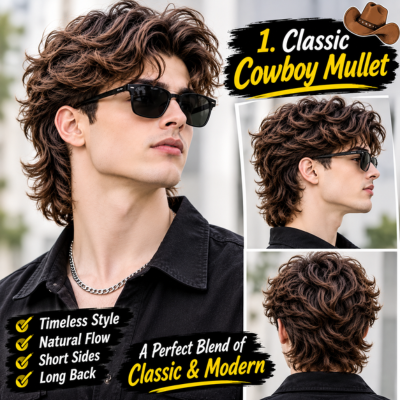
The classic cowboy mullet haircut is the simplest way into the trend. The top and sides are kept neat, and the back is left long enough to touch the collar. There are no extreme lines, so it looks balanced on most men.
This is the best starting point if you have never worn a mullet before. Ask your barber to blend the sides softly instead of cutting a hard line.
- Best for: Oval, square and oblong faces
- Styling product: Light pomade or sea salt spray
- Pairs well with: Denim jackets and a straw or felt hat
What it looks like. From the front, a classic cowboy mullet haircut reads as a neat, medium-length cut. The top sits about two to four inches long and can be swept back, pushed to the side or left with a soft fringe. The sides are cut closer and tapered above the ears. The surprise comes from behind, where the hair grows longer and lands somewhere between the nape and the shoulder blades.
How to ask your barber. Most bad haircuts come from vague requests. Instead of saying “give me a mullet,” try something like this: “I want a classic cowboy mullet haircut with a soft taper on the sides, some length on top and the back kept long enough to cover my collar. Please keep the line at the neck natural, not squared off.” That one sentence tells the barber the shape, the blend and the finish.
Step-by-step styling.
- Wash your hair with a gentle shampoo and condition the back section well.
- Towel dry until the hair is damp, not dripping.
- Apply a pea-sized amount of pomade or a few sprays of sea salt spray.
- Run your fingers through the top and push it in the direction you like.
- Let the back dry naturally so it keeps its soft weight.
Pros of the classic version.
- Looks balanced on most face shapes
- Easy to grow out or tone down later
- Works for both casual and smart-casual outfits
- Needs very little daily effort
Cons to keep in mind.
- The back can look flat on very fine hair without layers
- You need patience while the length grows in
- Neck hair needs a clean-up every few weeks
If you are still unsure, this is the safest choice on the list. It gives you a real feel for how a cowboy mullet haircut behaves before you try anything louder.
2. Textured Western Mullet
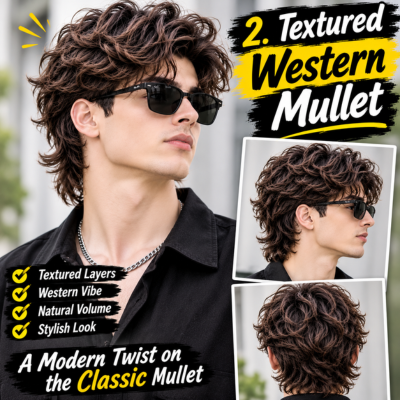
Texture is what gives a Western mullet its character. Your barber uses point cutting or light thinning to break up the lines so the hair moves freely instead of lying flat.
This style works well on fine or medium hair because the layers add body. A matte paste or clay helps you define the ends without making them stiff.
- Add a small amount of product to damp hair
- Scrunch the ends with your fingers
- Let it air dry for a natural finish
The cut behind the texture. A good textured Western mullet starts with the right technique. Barbers often use point cutting, which means snipping into the ends of the hair at an angle, so the ends look broken up instead of blunt. Some also use texturizing shears to remove weight in the thick parts. Together, these methods create separation, and separation is what makes the hair look alive.
Best hair types. This style is a strong match for fine and medium hair because the layers make thin strands look fuller. On very thick hair, it works too, but your barber should remove extra bulk so the shape does not turn into a triangle. On curly hair, keep the layers longer so the curls can still form.
Products that help.
| Product | What It Does | When To Use It |
| Matte clay | Adds grip and definition | Damp or dry hair, small amount |
| Sea salt spray | Builds beachy volume | Damp hair before drying |
| Texture powder | Lifts roots, adds dry texture | Dry hair, at the crown |
| Light cream | Controls frizz | Damp hair, ends only |
Common mistakes. Many men over-style this cut. If you pile on product, the texture clumps together and you lose the airy feel that makes a Western mullet special. Start small and add more only if you need it. Another mistake is brushing the hair when it is dry, which breaks up the layers and makes the back puff out.
Daily routine in under five minutes. Spray, scrunch, let it dry, then rough it up with a little clay. That is the whole process. If you are in a hurry, a quick tousle with your fingers is enough to wake the shape up.
This version of the cowboy mullet haircut is the one most barbers recommend to people who want a modern look without much fuss. It is forgiving, it grows out well, and it looks good from every angle.
3. Fade Cowboy Mullet
The fade cowboy mullet haircut keeps the sides tight and clean while the back stays long. The contrast is sharp, which gives the cut a modern, polished look. A low or mid fade is the most popular choice, and it grows out gracefully.
This is a good option if you work in a more formal setting but still want a cowboy mullet haircut with personality. Expect to visit your barber every three to four weeks to keep the fade crisp.
Which fade should you pick? The word fade covers several options, and each one changes the personality of the cut.
- Low fade: starts just above the ear and is the most conservative choice. It looks clean without being harsh.
- Mid fade: starts around the temple and gives a stronger contrast with the long back.
- High fade: starts high on the head and creates a bold, almost dramatic shape.
- Taper fade: only the hairline around the ears and neck is shortened, which gives the softest finish.
For a cowboy mullet haircut, the low or mid fade usually feels right. A very high fade can push the look toward punk, which may or may not be what you want.
How to talk to your barber. Say which fade you want and what guard number you prefer at the shortest point, or ask for a skin fade if you like it very sharp. Then describe the back: “Keep it long and textured, and blend into it instead of leaving a hard line.”
Upkeep schedule.
| Task | How Often |
| Fade refresh | Every 3 to 4 weeks |
| Shape trim at the back | Every 6 to 8 weeks |
| Neck clean-up at home | Weekly |
| Deep conditioning | Every 1 to 2 weeks |
Styling tips. Because the sides are so clean, the top and back do all the talking. Use a small amount of matte paste to define the top and a light cream through the back to keep it smooth. If you prefer the fade to look extra crisp, avoid heavy products near the sides.
Who it suits best. The fade version is a good pick for men who want a cowboy mullet haircut but need to look professional. It also suits men whose hair grows thick at the sides, since the fade removes that bulk. Men with very fine hair should ask for a softer taper instead, so the sides do not look too sparse.
4. Messy Cowboy Mullet
The messy cowboy mullet is the low-effort option. The layers are uneven on purpose, and the top is left tousled, which gives the cut a just-rolled-out-of-bed feel.
Because the style relies on imperfection, it forgives bad hair days. A bit of texture spray on dry hair is usually enough to bring it back to life.
Why messy works. Perfect hair can look stiff, and a Western look is supposed to feel natural. The messy cowboy mullet leans into that idea. The layers are cut at different lengths so the hair never lies in a perfect line, and that is exactly what gives the style its charm.
What your barber should do. Ask for choppy layers, a slightly uneven fringe and a back that is thinned at the ends. Tell them you want a “lived-in” finish. Good barbers understand this phrase and will avoid over-blending.
Five-minute messy styling method.
- Spray the hair lightly with texture spray while it is damp.
- Flip your head over and scrunch the roots for volume.
- Dry with a diffuser or let it air dry.
- Add a rice-grain-sized amount of paste on the fingertips.
- Pull and twist a few pieces at the front for a casual finish.
Hair types that work.
- Straight hair: add texture spray to create movement
- Wavy hair: let the waves form naturally
- Curly hair: define the curls, then separate them with your fingers
- Thick hair: ask for more thinning around the crown
What to avoid. Do not use heavy gel or hairspray on this style. Hard products flatten the layers and make the cut look wet instead of relaxed. Also avoid combing the hair into a neat shape, because the point of the look is controlled chaos.
Style it with confidence. A messy cowboy mullet haircut looks best when you own it. Walk in with a relaxed attitude, a worn-in jacket and boots, and the hair will look intentional. If it looks a little different each day, that is part of the appeal.
5. Curly Cowboy Mullet
If you have natural curls, a curly cowboy mullet haircut lets you use them as a feature. The curls add volume on top and a soft, springy texture through the back.
A light curl cream keeps the shape defined and cuts down on frizz. Avoid brushing dry curls, since it breaks up the pattern and creates puffiness. Use a wide-tooth comb on damp hair instead.
- Use a leave-in conditioner after washing
- Apply cream while the hair is still wet
- Diffuse on low heat or air dry
Why curls and mullets get along. Curly hair has natural volume and a springy shape, which makes it ideal for a mullet. The curls bounce on top and spiral through the back, so the cut looks full without extra work. Many barbers say curly mullets are among the easiest to wear because the texture does most of the styling.
Cutting tips for curls. Curly hair should be cut with care. Ask your barber to cut the curls dry or damp, so they can see where each curl actually falls. Cutting soaking wet curls can lead to surprises, because curls spring up once they dry. The layers should be long enough to keep the curl pattern intact, usually at least three inches on top.
Curly hair care routine.
| Step | Product | Tip |
| Cleanse | Sulfate-free shampoo | Wash two to three times a week |
| Condition | Rich conditioner | Focus on the long back section |
| Leave-in | Curl cream | Apply to soaking wet hair |
| Dry | Diffuser or air dry | Do not rub with a towel |
| Refresh | Water mist | Re-wet and scrunch on day two |
Managing frizz. Frizz is the main enemy of a curly cowboy mullet haircut. Sleep on a silk or satin pillowcase, or loosely tie the back section before bed. In the morning, mist with water and scrunch in a bit of cream. Avoid touching the curls too much while they dry, since that is when frizz forms.
Fade or no fade? Both work. A soft fade on the sides gives the curls a clean frame, while a no-fade version looks looser and more relaxed. If you have tight coils, a skin fade can look especially sharp against the volume on top.
Grow-out phase. During growth, curls tend to expand outward before they fall down, which can create a pyramid shape. Ask for regular shape-ups, and let the back grow while keeping the sides tidy. In a few months, the weight pulls the curls down and the mullet takes its final form.
6. Wavy Flow Mullet
The wavy flow mullet is a relaxed, medium-to-long style that lets natural waves do the work. The hair falls loosely around the ears and gathers at the back, which gives it a surfer-meets-rancher feel.
Wavy hair is easy to shape into this look because it already has movement. A mousse or sea salt spray will boost definition without weighing the hair down.
The shape in detail. The wavy flow mullet keeps the top at a medium length, usually three to five inches, so the waves have room to move. The sides are cut with scissors or clippers on a light guard and blended softly. At the back, the hair runs long and is cut in gentle layers so the waves stack on each other instead of hanging in a heavy block.
Why it feels so easy. Wavy hair sits between straight and curly, so it takes the best from both. It has enough texture to hold a shape, and enough softness to look smooth. That balance is why a wavy cowboy mullet haircut often needs less product than any other version.
Daily routine.
- Wash with a hydrating shampoo and rinse with cool water to help seal the cuticle.
- Squeeze out extra water with a cotton t-shirt, not a rough towel.
- Apply mousse or sea salt spray from the mid-lengths to the ends.
- Scrunch upward to encourage the waves.
- Air dry or use a diffuser on a low setting.
Helpful tips.
- Do not over-wash. Washing three to four times a week keeps natural oils in the hair.
- Use a leave-in conditioner on the long section to prevent dryness.
- Skip heavy waxes, which can weigh waves down and make them look limp.
- Trim split ends every eight weeks to keep the flow smooth.
For straight-haired men. If your hair is naturally straight, you can still wear this cut. Ask for a body wave perm, or use salt spray and a diffuser to fake the movement. Many men also braid damp hair overnight to get loose, natural-looking waves by morning.
Outfit match. The relaxed shape pairs well with linen shirts, light jackets and canvas hats in warm weather. In winter, a beanie can flatten the top, so choose a looser knit and fluff the hair once you remove it. Overall, the wavy flow version of the cowboy mullet haircut gives you a free-spirited look that is surprisingly easy to maintain.
7. Razor Cut Cowboy Mullet
A razor cut cowboy mullet haircut uses a razor instead of scissors to create feathered, wispy ends. The result is soft, light and slightly rough around the edges.
This technique is especially useful for thick or heavy hair, because it removes bulk and improves movement. Fine hair can look overly thin with razor work, so talk to your barber first.
Why a razor? Scissors cut hair at a flat, blunt angle. A razor slices through the strands at a slant, which tapers the ends to a fine point. The result is a lighter, softer look that sits naturally, with no hard edges. That is why a razor cut cowboy mullet haircut looks so organic.
Ideal candidates. Men with thick, coarse or heavy hair benefit the most. The razor removes weight, which makes the mullet easier to style and more comfortable in warm weather. Men with fine or damaged hair should be careful, because the technique can make the ends look thin and may lead to frizz.
What to tell your barber. Ask whether your barber is comfortable with razor work. This is a skill, and not every barber does it often. Say something like: “I would like a razor-cut finish through the back and the top, with soft, feathered ends and a natural taper on the sides.”
Razor cut vs scissor cut.
| Feature | Razor Cut | Scissor Cut |
| Edge finish | Soft and feathered | Clean and blunt |
| Best for | Thick, coarse hair | Fine to medium hair |
| Volume | Reduces bulk | Keeps fullness |
| Texture | Visible, wispy | Smooth, even |
| Risk | Frizz on dry hair | Can look heavy |
Aftercare matters. Razor-cut ends are more delicate, so treat them gently. Use a nourishing conditioner, and a leave-in product with some moisture to keep the ends smooth. Skip harsh clarifying shampoos too often, since they strip moisture and lead to frizz.
Styling approach. Work a small amount of cream or paste through damp hair, then let it dry. The razor cut has built-in movement, so you only need to guide it. If you like more definition, finish with a dab of matte wax on the very ends.
Maintenance. Razor cuts lose their shape faster than scissor cuts because the ends are so fine. Book a trim every five to six weeks, and your cowboy mullet haircut will keep its soft, airy shape.
8. Shaggy Cowboy Mullet
The shaggy cowboy mullet is the layered, rock-and-roll version of the cut. It combines choppy layers on top with a long, textured back, and the overall effect is full and bold.
This style suits men who want volume and do not mind a slightly wild look. A sea salt spray and a quick blow-dry with your fingers will keep the shape fluffy.
The look. The shaggy cowboy mullet is full of layers. The top is cut in choppy sections that fall over the forehead and ears, and the back is long, wispy and slightly uneven. It borrows from seventies rock style, but the Western twist keeps it grounded and a little rugged.
What makes it shaggy. Three things create the effect: heavy layering, plenty of texture and enough length to let the layers overlap. Without those, it looks like a regular mullet. If your barber is not sure, show a photo and point to the exact feeling you want.
Best hair types. Wavy and slightly thick hair is ideal. It holds layers well and gives that fluffy finish. Straight, fine hair can look limp if the layers are too short, so ask for longer layers or add volume with a salt spray. Curly hair gives an even bolder result, but it needs regular shaping to avoid turning round.
Styling steps.
- Apply sea salt spray to damp hair.
- Blow dry roughly with your fingers, lifting at the roots.
- Add a small amount of texture powder at the crown for lift.
- Twist a few pieces with a bit of paste.
- Leave the rest alone.
Pros and cons.
| Pros | Cons |
| Makes a strong style statement | Needs regular trimming to keep layers tidy |
| Hides fine lines and thin spots near the hairline | Can feel warm in summer |
| Looks great with relaxed outfits | May look too wild for strict dress codes |
| Grows out gracefully | Requires patience in the early weeks |
Tips for a polished shag. Even though the shape is messy, the hair itself should look healthy. Condition the long back section often, avoid too much heat and trim the ends every six to eight weeks. A messy cut on healthy hair looks intentional, while a messy cut on dry hair looks neglected.
If you want a cowboy mullet haircut that turns heads, the shaggy version is the one to choose.
9. Short Cowboy Mullet
The short cowboy mullet haircut is the “baby mullet” of the group. The back is only a little longer than the sides, so the style is subtle and easy to wear to work.
It is also a good transition cut if you are growing your hair out. You get the shape of a mullet without committing to length.
- Best for: Professional settings and first-time mullet wearers
- Styling product: Matte clay or paste
- Trim schedule: Every four to five weeks
A gentler entry point. The short cowboy mullet haircut is for the man who likes the idea of a mullet but does not want a dramatic change. The back is only about one to two inches longer than the sides, so it looks like a textured, slightly longer cut from the side and like a normal haircut from the front.
Why it works in an office. The look is tidy, it fits under a collar and it does not scream for attention. Yet there is a hint of personality, since the longer back and texture on top show you made a choice. Many men use it as a stepping stone before they commit to a longer version.
How to ask for it. “I would like a short cowboy mullet haircut with a taper on the sides and just a little extra length at the back. Keep the top textured and easy to style.”
Styling guide.
| Look | Product | Method |
| Natural | Light cream | Rub in palms, run through hair |
| Textured | Matte clay | Rub in palms, scrunch top |
| Sleek | Pomade | Comb back on damp hair |
| Casual | Sea salt spray | Spritz, dry, tousle |
Growing it into something longer. If you want to grow the back out, leave the length alone and keep trimming the sides and top. Within three to four months, you will have a medium mullet. During this awkward stage, use a small amount of paste to tuck the back behind your ears and keep it neat.
Best face shapes. The short version flatters almost every face shape because it is so balanced. Round faces benefit from a bit of height on top, and long faces benefit from a side-swept fringe to add width.
Quick tips.
- Keep the neckline soft instead of squared off
- Use a matte product to avoid a shiny look
- Trim every four to five weeks to keep the back tidy
- Pair with a clean-shaven face or a short beard for a polished effect
The short cowboy mullet haircut is proof that a bold trend can be adapted to almost any lifestyle.
10. Long Flow Cowboy Mullet
The long flow cowboy mullet is the most dramatic style on this list. The back reaches the shoulders or past them, and the hair moves with every step.
This cut needs patience and care. Keep the ends healthy with regular trims and a good conditioner, and use a leave-in product to prevent tangles. If you like the idea of a statement hairstyle, nothing beats this one.
Before you start. A long flow cowboy mullet takes months to grow. Most men need at least six to twelve months of growth, depending on how fast their hair grows and how long they want the back. Do not rush the process, and do not skip trims, because healthy ends make the difference between a flowing mane and a scruffy tangle.
Growth timeline.
| Stage | Approx. Time | What to Do |
| Starting out | Months 1 to 2 | Keep the sides tidy, let the back grow |
| Awkward phase | Months 3 to 5 | Use paste to control flyaways |
| Taking shape | Months 6 to 8 | Add layers to avoid a heavy back |
| Full flow | Months 9 to 12 | Maintain with trims every 8 to 10 weeks |
Care essentials. Long hair needs more care than short hair. Wash it two to three times a week with a gentle shampoo, and condition from mid-length to the ends. Detangle gently with a wide-tooth comb, starting from the bottom. Use a leave-in conditioner or a few drops of lightweight oil to protect the ends.
Styling options.
- Loose and natural: let it fall and add a little cream for shine
- Half-up: tie the top section back with a simple elastic
- Tucked: tuck the sides behind the ears for a cleaner look
- Hat-ready: brush the back smooth so it sits neatly under a brim
Sleep and protection. Use a silk or satin pillowcase, or tie your hair loosely at night. This reduces friction, which causes breakage and tangles.
Is it right for you? Long flow suits men with medium to thick hair and a confident personality. If you work in a conservative setting, you may prefer to keep the hair tied back during the week. The good news is that a long cowboy mullet haircut can be cut shorter at any time, so there is little risk in trying it.
Final styling thought. The long flow version is a statement. It says you are comfortable standing out, and it pairs especially well with rugged outfits such as worn denim, leather boots and a classic hat.
How to Choose the Right Cowboy Mullet Haircut for Your Face Shape
The best cowboy mullet haircut for you depends on your face shape and your hair type. Use these quick guidelines.
| Face Shape | Recommended Style |
| Oval | Almost any style, especially the classic or fade version |
| Square | Textured, wavy or shaggy styles that soften the jaw |
| Round | Fade or razor cut styles with height on top |
| Oblong | Messy or curly styles that add width |
| Diamond | Wavy flow or shaggy styles that balance the cheekbones |
Best Cowboy Mullet Haircut for Your Hair Type
Face shape matters, but hair type matters even more. A cut that fights your natural texture will take more time and more product every morning. Use this table to match your hair to the right style.
| Hair Type | Best Styles | Styling Tip |
| Straight | Classic, fade, razor cut | Add texture spray for movement |
| Wavy | Wavy flow, textured, shaggy | Use mousse and air dry |
| Curly | Curly cowboy mullet, shaggy | Use curl cream on wet hair |
| Coily | Curly cowboy mullet with a fade | Moisturize often, detangle gently |
| Fine | Textured, short cowboy mullet | Use light products, ask for layers |
| Thick | Razor cut, fade, shaggy | Ask for thinning to remove bulk |
Straight hair
Straight hair can look sleek and sharp, but it can also fall flat. The solution is texture. Ask your barber for point cutting and layers, and rely on sea salt spray or texture powder to build volume. A cowboy mullet haircut on straight hair has a clean, modern look that is easy to maintain.
Wavy and curly hair
These hair types are practically made for the mullet. The natural bend gives volume and movement without effort. Focus on moisture, use the right products and avoid brushing dry hair. Both hair types also hide small cutting mistakes better than straight hair does.
Fine or thinning hair
Fine hair benefits from layers and a shorter back, because long, thin strands can look wispy. Choose the textured or short version, and keep the top full with a light volumizing product. If you have a receding hairline, a longer fringe or a side sweep can soften the area.
How to Talk to Your Barber About a Cowboy Mullet Haircut
The best haircuts begin with a clear conversation. Here is a simple method that works for almost every client.
- Bring two or three photos. Show the front, side and back of the cut you like.
- Describe the length. Say how long you want the top and where the back should end, for example at the nape or the shoulder.
- Choose the sides. Tell the barber whether you want a fade, a taper or scissor-cut sides.
- Explain the finish. Words like soft, textured, messy or polished help a lot.
- Mention your routine. If you only have five minutes in the morning, say so.
- Ask for styling advice. A good barber will show you how to recreate the look at home.
It also helps to book a consultation before your first cut if your barber offers one. A short talk can prevent a lot of regret.
Best Products for a Cowboy Mullet Haircut
You do not need a bathroom full of products. A few well-chosen items can handle almost any version of the cowboy mullet haircut.
| Product Type | Best For | How To Apply |
| Sea salt spray | Beachy texture and volume | Spray on damp hair, scrunch |
| Matte clay | Definition without shine | Warm in palms, work through dry hair |
| Light pomade | A neater, controlled look | Use sparingly on damp hair |
| Curl cream | Curls and waves | Apply to wet hair, scrunch upward |
| Leave-in conditioner | Long, dry ends | Apply from mid-lengths to ends |
| Texture powder | Instant lift at the roots | Sprinkle and rub at the crown |
How much is enough? Start with a coin-sized amount for most products, and add more only if needed. It is easier to add product than to wash out too much.
Shampoo and conditioner. Choose a gentle, sulfate-free shampoo for curly or dry hair, and a clarifying shampoo once every two weeks if you use a lot of styling products. Always condition the long section, because it is the oldest hair on your head and needs the most care.
Fashion and Lifestyle Pairing
A cowboy mullet haircut looks best when the rest of your outfit supports the Western mood. You do not need a full costume. A few well-chosen pieces will do the job.
- Denim: A denim jacket or classic straight-leg jeans fit naturally
- Boots: Leather cowboy or Chelsea boots complete the look
- Hats: A felt or straw cowboy hat works if the back of your hair is kept tidy
- Accessories: A leather belt, a simple silver ring or a bandana add character
- Fabrics: Flannel, suede and worn-in cotton match the relaxed finish of the cut
The style also works with casual streetwear. Pair it with a plain tee, a bomber jacket and sneakers for a modern, city-friendly version of the cowboy mullet haircut.
Cowboy Mullet Haircut With Beards, Hats and Accessories
The hair is only part of the picture. Facial hair, headwear and small details change how the cut reads.
Beards. A short, well-kept beard balances the length at the back and gives the face structure. A stubble beard keeps things casual, a trimmed full beard adds a rugged edge, and a clean-shaven face makes the haircut the star. Avoid a very long beard together with a very long mullet, which can overwhelm the face.
| Facial Hair | Overall Effect | Best Mullet Pairing |
| Clean-shaven | Sharp and youthful | Fade or short version |
| Light stubble | Relaxed and modern | Textured or messy version |
| Short beard | Rugged and balanced | Classic or wavy version |
| Full beard | Bold and Western | Shaggy or long flow version |
Hats. A cowboy hat looks great with a cowboy mullet haircut if the fit is right. Choose a hat that sits comfortably without crushing the top. Let the back hang out naturally, and tidy the sides so they do not stick out awkwardly. Baseball caps and bucket hats also work, especially with the shorter versions.
Accessories. Small details help. A leather bracelet, a simple chain or a pair of aviator sunglasses can finish the look without turning it into a costume.
Seasonal outfits.
- Spring: denim shirt, light jacket and clean boots
- Summer: linen shirt, shorts and a straw hat
- Autumn: flannel, suede jacket and dark jeans
- Winter: wool coat, scarf and a loose knit beanie
How to Grow Out Your Hair for a Cowboy Mullet Haircut
If you are starting from short hair, the grow-out phase is the hardest part. These steps make it easier.
- Stop cutting the back. Leave the nape and crown alone from day one.
- Keep the sides short. Regular clipper maintenance stops the shape from turning into a bowl.
- Trim the ends every eight to ten weeks. This keeps hair healthy and removes split ends.
- Use a hair-growth friendly routine. Eat well, sleep enough and massage the scalp while washing.
- Be patient. Hair grows about half an inch per month on average, so a five-inch gain takes close to ten months.
- Ask for interim shaping. A barber can create a temporary shape that looks intentional while you wait.
How to survive the awkward stage. Use a small amount of paste to tame the back, wear a hat when you need to, and try tucking the sides behind your ears. A headband or small clip also works for short stretches.
Common Cowboy Mullet Haircut Mistakes to Avoid
Even a great cut can look wrong if a few details are off. Watch for these common problems.
- Cutting the back too short. Once the length is gone, you have to wait months to get it back.
- Leaving a hard line. A harsh line between the top and the back makes the cut look dated.
- Using too much product. Heavy gel or wax makes the hair look greasy.
- Ignoring split ends. Dry, broken ends ruin the effect of a long cut.
- Skipping trims. Without regular care, the shape grows out of balance.
- Copying a photo without checking your hair type. Straight hair will not behave like curly hair, no matter how good the picture looks.
- Forgetting the neckline. An untidy neckline can make the whole look seem neglected.
Cowboy Mullet Haircut Maintenance Schedule
A simple schedule keeps your haircut looking fresh without taking over your life.
| Task | Frequency | Notes |
| Wash | 2 to 4 times a week | Depends on hair type and activity |
| Deep condition | Once a week | Focus on the back |
| Neck and sides clean-up | Every 2 to 4 weeks | Faded versions need it more often |
| Full barber visit | Every 4 to 6 weeks | Trim shape and refresh layers |
| Long hair trim | Every 8 to 10 weeks | Remove split ends only |
| Product check | Monthly | Replace anything that no longer works for your hair |
Healthy hair habits. Drink plenty of water, protect your hair from strong sun with a hat, and rinse after swimming. Use heat styling sparingly, and always apply a heat protectant if you do. These small habits keep the long back section strong and shiny.
Cowboy Mullet Haircut: Pros and Cons
Before you commit, weigh the good and the bad.
| Pros | Cons |
| Stands out without looking over the top | Takes time to grow if you start short |
| Works with many hair types and face shapes | Back section needs regular care |
| Easy to style in minutes | Can feel warm in summer |
| Pairs well with casual and Western outfits | Strict workplaces may frown on longer versions |
| Can be adjusted from short to long | Poorly cut versions look dated |
Overall, the benefits outweigh the drawbacks for most men, especially when the cut is tailored to their hair and lifestyle.
Styling and Maintenance Tips
A cowboy mullet haircut is easy to wear but it still needs a routine. These simple habits will keep it in shape.
- Trim regularly. Visit your barber every four to six weeks to keep the shape from growing out unevenly.
- Choose the right shampoo. Use a gentle shampoo and a conditioner on the long back section to prevent dryness.
- Use light products. Sea salt spray, matte clay or light cream give texture without heaviness.
- Avoid too much heat. Let your hair air dry when you can, and use a heat protectant if you style it.
- Brush carefully. Detangle the long back from the ends upward, using a wide-tooth comb.
- Bring a photo. A reference picture helps your barber understand the exact cowboy mullet haircut you want.
Tools Worth Owning for a Cowboy Mullet Haircut
- A wide-tooth comb
- A texture or sea salt spray
- A matte paste or clay
- A small pair of scissors for light neck cleanups
Frequently Asked Questions
What Is a Cowboy Mullet Haircut?
A cowboy mullet haircut is a Western-inspired mullet with shorter hair on the top and sides and a longer, textured back. The finish is loose and natural rather than sharp.
Is It Easy to Maintain?
Mostly yes. Short and textured versions need only a trim every four to six weeks, while fade and long flow versions need more frequent upkeep.
Who Should Try This Haircut?
Anyone who wants a bold but wearable cut can try it, especially men with medium to thick hair who like a relaxed, rugged style.
Does It Suit Straight Hair?
Yes. Straight hair works well with the classic, fade and razor cut versions, and a texture spray adds the movement it may lack naturally.
Is It Still Trending?
Yes. Mullet-inspired cuts remain a major men’s hair trend in 2026, and the Western version stands out for its relaxed, modern feel.
Final words
The cowboy mullet haircut is more than a nostalgic throwback. It is a flexible, expressive cut that can be softened for the office or pushed further for a night out. Start by choosing the style that fits your hair type and your daily routine, bring a clear reference photo to your barber and commit to regular trims. With the right cowboy mullet haircut and a simple care routine, you will look confident, current and unmistakably yours in 2026.
