

By Hair Style Editorial Team
The curtain mullet is having a big moment in 2026. It takes the soft, center-parted look of 90s curtain hair and blends it with the length and attitude of a modern mullet. The result is a cut that feels relaxed, a little rebellious, and very easy to wear.
If you are scrolling through photos and wondering which curtain mullet suits you, this guide is for you. You will learn what the cut is, why it is trending, and 24 fresh curtain mullet haircut styles. You will also find face shape advice, daily styling steps, and simple maintenance tips.
Whether your hair is straight, wavy, or curly, there is a version here that fits your hair and your lifestyle. Let’s get into it.
What Is a Curtain Mullet?
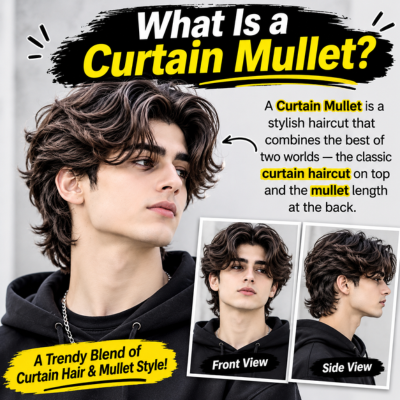
A curtain mullet is a hybrid haircut. The front is parted in the middle (or slightly off-center) so the hair falls to both sides of the face like curtains. The back is left longer, so you get the classic mullet shape from the side and behind.
In simple words, it is curtain hair up front and mullet length at the back.
Here are the key features that define the cut:
- Center or soft side part: the hair splits and frames the forehead and cheekbones.
- Longer back section: the nape and neckline carry extra length, often with layers.
- Shorter or tapered sides: the sides can be faded, tapered, or simply kept tidy.
- Texture and movement: layers make the hair look natural instead of stiff.
The modern version is far softer than the harsh 80s mullet. Stylists today blend the lengths so the shape looks smooth, not chopped. That is why many people call it the “grown-out luxury” look. It looks like you just woke up with great hair, even though a good barber planned every layer.
Curtain Mullet vs. Classic Mullet vs. Curtain Haircut

| Feature | Curtain Mullet | Classic Mullet | Curtain Haircut |
| Front | Middle part, face-framing | Short and often spiky | Middle part, medium length |
| Back | Longer, layered | Long, sometimes choppy | Usually same length as top |
| Sides | Tapered or fade (optional) | Short | Medium or tapered |
| Overall vibe | Soft, modern, relaxed | Bold, retro | Clean, 90s-inspired |
| Maintenance | Medium | Medium to high | Low to medium |
Why Is the Curtain Mullet So Popular?
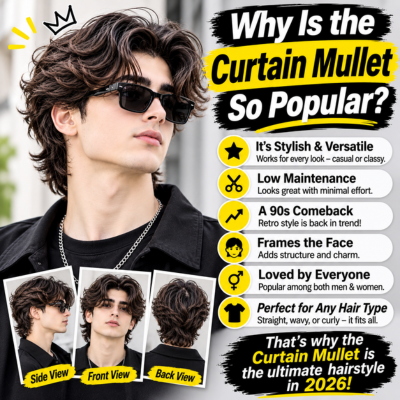
The popularity of the curtain mullet comes from a mix of social media, nostalgia, and practicality. Several trend reports for 2026 point to curtain-style fringes and mullet-inspired shapes as two of the biggest men’s hair directions of the year. This cut sits right where both trends meet.
Here are the main reasons people keep asking their barbers for it:
- It flatters many faces. The curtain fringe softens the forehead, while the longer back adds balance.
- It feels personal. You can tweak the length, fade, and texture until it looks like you.
- Social media loves it. Short videos and photos show off the movement of layered hair beautifully.
- It borrows from Korean and 90s style. Soft, parted fringes have been a staple of K-pop and K-drama looks for years, and 90s nostalgia keeps them fresh.
- It is easy to grow out. If you are in between haircuts, a curtain mullet is a smart stop on the way to longer hair.
- It looks natural. The 2026 mood is less “perfect” and more effortless, and this haircut fits that mood well.
In short, the curtain mullet gives you attitude without looking forced. That balance is exactly what people want right now.
24 Curtain Mullet Haircut Styles

Below are 24 curtain mullet haircut ideas, grouped by their main feature. For each one you will see who it suits, what to tell your barber, and a quick styling tip. Pick two or three favorites and save reference photos before your appointment.
Here is a quick overview before we go deeper:
| # | Style | Best For | Maintenance |
| 1 | Classic | First-timers | Medium |
| 2 | Textured | Fine to medium hair | Low |
| 3 | Low Taper | Office-friendly look | Medium |
| 4 | Mid Fade | Clean contrast | High |
| 5 | Burst Fade | Bold, curved edges | High |
| 6 | Skin Fade | Sharp, high-contrast look | High |
| 7 | Korean | Soft, airy fringe | Medium |
| 8 | Shaggy | Messy, layered fans | Low |
| 9 | Short | Minimal commitment | Low |
| 10 | Long | Hair growers | High |
| 11 | Curly | Natural curls | Medium |
| 12 | Wavy | Natural waves | Low |
| 13 | Straight Hair | Sleek finish | Medium |
| 14 | Wolf Cut | Maximum texture | Medium |
| 15 | Layered | Volume and movement | Medium |
| 16 | Razor Cut | Feathered ends | Medium |
| 17 | Messy | Casual daily wear | Low |
| 18 | Taper Fade | Neat neckline | Medium |
| 19 | Undercut | Thick hair control | High |
| 20 | Fringe Heavy | Strong forehead frame | Medium |
| 21 | Voluminous | Thin or flat hair | Medium |
| 22 | Soft | Gentle, natural finish | Low |
| 23 | Modern | Trend-forward look | Medium |
| 24 | With Highlights | Color lovers | High |
Classic Curtain Mullet
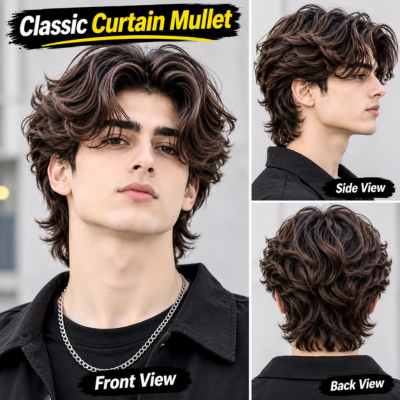
The classic curtain mullet is the easiest place to start. The top is kept at a medium length and parted down the middle. The back grows a few inches longer than the sides and ends in a soft, slightly layered line.
This version works because nothing about it is extreme. The lengths blend gradually, so it looks balanced from every angle.
- Best for: anyone trying a mullet for the first time.
- Ask your barber for: a center part, light layering on top, and a back that is two to four inches longer than the sides.
- Styling tip: blow-dry the front away from the center with your fingers, then finish with a light cream.
It is also the safest choice if your workplace or school has a relaxed but neat dress code.
Textured Curtain Mullet
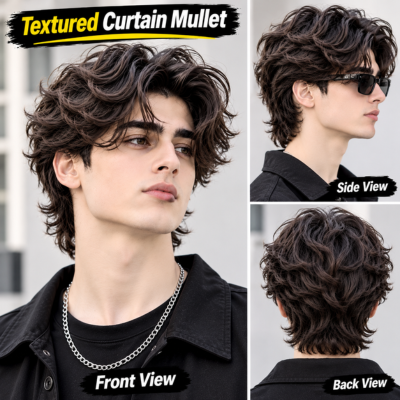
A textured curtain mullet relies on choppy layers to create movement. Instead of smooth, even lengths, your barber cuts into the ends so the hair separates and looks a little rough in a good way.
This style is perfect when you want your hair to look full without effort. Texture hides flat spots and makes fine hair appear thicker.
- Best for: fine to medium hair that needs body.
- Ask your barber for: point cutting through the ends and slightly shorter layers on top.
- Styling tip: use a sea salt spray on damp hair, scrunch lightly, and let it air-dry.
Avoid heavy gels here. They flatten the texture that makes the cut interesting.
Low Taper Curtain Mullet
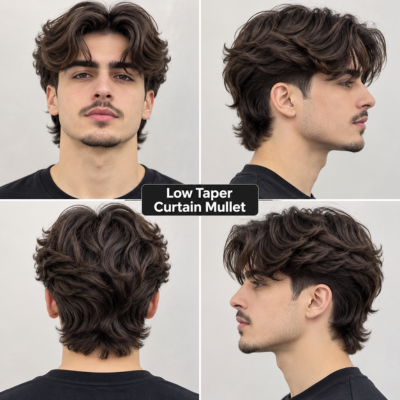
The low taper curtain mullet keeps the sides clean without showing much skin. The taper begins low, just above the ears and around the neckline, and fades gently into the longer hair above.
This cut looks sharp but not aggressive. It is a popular option for people who like a polished edge around the ears while keeping a relaxed fringe.
- Best for: office settings and anyone who wants a clean outline.
- Ask your barber for: a low taper, a soft center part, and a natural nape.
- Styling tip: a small amount of matte paste on the top section keeps the curtains in place.
Because the taper is subtle, it grows out gracefully between appointments.
Mid Fade Curtain Mullet
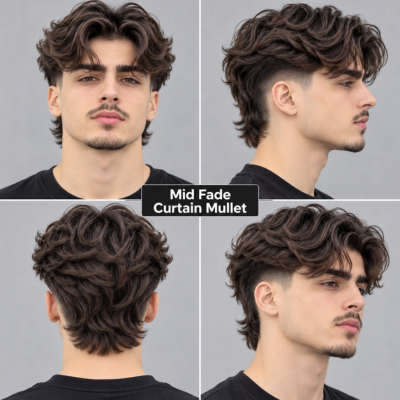
The mid fade curtain mullet adds more contrast. The sides fade down to a shorter length around the middle of the head, which makes the longer top and back stand out even more.
This style gives a modern, sporty look and highlights the shape of the curtain fringe.
- Best for: people who like strong lines and a fresh barbershop finish.
- Ask your barber for: a mid fade, a disconnected or blended top, and long back sections.
- Styling tip: keep the top soft and natural so the fade does the dramatic work.
Expect to visit your barber every three to four weeks to keep the fade crisp.
Burst Fade Curtain Mullet
A burst fade curves around the ear in a semicircle and leaves length at the nape. That makes it a natural partner for a mullet, because the longer back stays intact while the sides are cleaned up.
The curtain mullet with a burst fade looks bold and trendy, and it is especially popular on thick or curly hair.
- Best for: confident dressers and people with textured hair.
- Ask your barber for: a burst fade around the ears with a curtain top and a longer back.
- Styling tip: apply a curl cream or light pomade to keep the top defined.
Because the fade is detailed, choose a barber who is comfortable with creative fades.
Skin Fade Curtain Mullet
The skin fade curtain mullet drops the sides all the way down to bare skin. Against the soft curtain fringe and flowing back, it produces a striking contrast.
It is one of the sharpest looks on this list and works well for thick hair that needs thinning out at the sides.
- Best for: people who want a clean, high-contrast style.
- Ask your barber for: a skin fade that blends into a longer top and an untouched mullet back.
- Styling tip: use a bit of sea salt spray on top to keep the look relaxed against the sharp sides.
This style needs regular upkeep. Plan on a trim every three weeks or so.
Korean Curtain Mullet
The Korean curtain mullet is soft, airy, and slightly dreamy. The fringe is longer and parted in the center, usually with light see-through ends over the forehead. The back keeps a gentle length with smooth layers.
Korean style trends have pushed soft fringes into the mainstream, and this version feels elegant without trying too hard.
- Best for: straight or slightly wavy hair and people who like a clean, youthful look.
- Ask your barber for: thinned fringe ends, a center part, and a rounded back shape.
- Styling tip: dry your hair with a round brush or your fingers, then set it with a light hairspray.
A perm or soft wave treatment can add extra lift if your hair is very flat.
Shaggy Curtain Mullet
If you love messy hair, the shaggy curtain mullet is your cut. Long, uneven layers run through the whole head, and the curtain part blends into a lived-in back.
The look is relaxed, creative, and a little rock and roll.
- Best for: wavy hair and people who dislike styling.
- Ask your barber for: a shaggy cut with long layers, a center part, and a softly tapered nape.
- Styling tip: let it dry naturally and add a small drop of hair oil to the ends.
One thing to remember: shaggy does not mean careless. Regular layering trims still keep the shape from turning into a bush.
Short Curtain Mullet
Not ready for long hair? The short curtain mullet keeps everything compact. The fringe is just long enough to split in the middle, and the back is only slightly longer than the sides.
It is a great low-commitment option and easy to dress up or down.
- Best for: beginners and people with busy mornings.
- Ask your barber for: a short top with a small center part and a subtle back extension.
- Styling tip: work in a dab of clay and push the fringe to each side while the hair is slightly damp.
If you later decide to grow it longer, this cut is an easy starting point.
Long Curtain Mullet
The long curtain mullet takes the style to its fullest. The fringe reaches the cheekbones or jaw, and the back flows past the collar or even the shoulders.
This is a statement cut that looks dramatic with a good layering job.
- Best for: people with thick or healthy hair who want a bold, flowing look.
- Ask your barber for: long layers, a center part, and a rounded or V-shaped back.
- Styling tip: use a leave-in conditioner to keep the length smooth, and trim split ends regularly.
Long hair needs more care. A weekly conditioning routine makes a visible difference.
Curly Curtain Mullet
Curly hair and mullets get along beautifully. In a curly curtain mullet, the curls fall naturally on both sides of the center part, and the back forms a springy mass of length.
The key is cutting the hair dry or in its natural pattern so the layers sit correctly.
- Best for: natural curls and coils.
- Ask your barber for: a curl-friendly cut with shaped layers and a tapered or faded side.
- Styling tip: apply curl cream on wet hair, scrunch, and diffuse on low heat.
Avoid brushing dry curls. A wide-tooth comb or your fingers keep the pattern defined.
Wavy Curtain Mullet
Wavy hair is probably the easiest canvas for this cut. The waves create natural separation in the fringe, and the back looks full without much work.
The wavy curtain mullet is casual, stylish, and works in almost any season.
- Best for: medium-thick wavy hair.
- Ask your barber for: weighted layers that support the wave pattern.
- Styling tip: air-dry with a light mousse or sea salt spray for a beachy finish.
If your waves tend to frizz, a small amount of smoothing serum controls it.
Straight Hair Curtain Mullet
Straight hair gives the curtain mullet a sleek, almost editorial finish. The fringe falls in smooth panels on each side, and the back drops in a clean line.
Because straight hair shows every cutting mistake, this style depends on precise technique.
- Best for: fine or medium straight hair.
- Ask your barber for: soft internal layers so the hair doesn’t hang flat, plus a slightly curved back line.
- Styling tip: blow-dry the fringe outward, then add a light volumizing spray at the roots.
If your hair is very straight and heavy, ask for thinning in the mid-lengths so it moves better.
Wolf Cut Curtain Mullet
The wolf cut curtain mullet merges two of 2026’s most talked-about shapes. You get the heavy layering and shaggy top of a wolf cut, plus the center-parted curtains and mullet length.
It looks wild but wearable, and it is one of the most photographed versions of the cut right now.
- Best for: thick or wavy hair and anyone who wants maximum volume.
- Ask your barber for: shorter crown layers, longer ends at the back, and a face-framing center part.
- Styling tip: twist small sections with texturizing paste and let them stay uneven.
The wolf version grows out quickly, so you can stretch the time between trims.
Layered Curtain Mullet
Layers are what make any curtain mullet feel lighter. A layered curtain mullet uses long, medium, and short layers that blend from the fringe to the nape.
The result is a style that moves when you walk and never looks like a solid block of hair.
- Best for: medium to thick hair that feels heavy.
- Ask your barber for: a layered cut with gradual graduation and no harsh lines.
- Styling tip: apply a lightweight mousse and blow-dry upward at the roots for lift.
Good layering also makes daily styling faster, because the cut does most of the work for you.
Razor Cut Curtain Mullet
A razor cut curtain mullet uses a razor instead of scissors to create feathered, wispy ends. The edges look soft and slightly broken, which gives the hair a lived-in finish.
It is popular because it removes bulk without making the hair look thin when done correctly.
- Best for: thick, straight, or slightly wavy hair.
- Ask your barber for: razor texturizing at the ends and a light touch around the fringe.
- Styling tip: skip tight hair ties and rough towel drying, since razored ends can fray.
Razor cutting is not ideal for very dry or damaged hair, so check your hair health first.
Messy Curtain Mullet
The messy curtain mullet is for people who want to roll out of bed and still look good. The pieces are uneven on purpose, and the part doesn’t need to be perfect.
It is a casual, youthful cut that suits streetwear, denim, and everyday outfits.
- Best for: wavy or lightly curly hair.
- Ask your barber for: choppy layers and a loose center part.
- Styling tip: rake in a small amount of matte clay and leave it alone.
Messy works best when the haircut underneath is sharp, so don’t skip regular trims.
Taper Fade Curtain Mullet
The taper fade curtain mullet is slightly different from the low taper version. Here, the taper runs higher around the sides and neckline, creating a tidy, rounded shape.
The longer top and back stay full while the edges look neat.
- Best for: people who want a smooth outline and a polished look.
- Ask your barber for: a medium taper that blends into the curtain top and mullet back.
- Styling tip: use a light sea salt spray to keep the top soft against the clean sides.
It is a solid choice if you are balancing a creative style with a professional job.
Undercut Curtain Mullet
An undercut curtain mullet removes bulk from underneath and leaves the top and back long. When you wear it down, you get a normal curtain mullet. When you tie it up, the shaved underlayer appears.
This gives you two looks from one haircut.
- Best for: very thick hair that feels too heavy.
- Ask your barber for: a hidden undercut at the nape or sides with long hair kept on top.
- Styling tip: keep the undercut tidy with a trimmer at home between visits.
The undercut grows out visibly, so plan salon visits every three to four weeks.
Fringe Heavy Curtain Mullet
This one puts all the focus on the front. The fringe is thick, long, and parted wide, and it frames the whole upper face. The back stays comparatively simple.
It is dramatic, a bit moody, and very photogenic.
- Best for: people with a high forehead or those who like a bold face frame.
- Ask your barber for: a deep fringe that reaches the eyebrows or cheekbones.
- Styling tip: use a fine-tooth comb and a touch of cream to keep the curtains separate.
If the fringe falls into your eyes, a quick clip or a tuck behind the ears solves it.
Voluminous Curtain Mullet
A voluminous curtain mullet is built for fullness. The roots are lifted, the layers are plentiful, and the whole shape looks bouncy.
This is a great way to make fine or thin hair appear thicker.
- Best for: fine, thin, or flat hair.
- Ask your barber for: short layers around the crown and longer ones at the back.
- Styling tip: blow-dry with your head tilted down, then finish with a flexible-hold spray.
A volumizing shampoo also helps. Heavy oils work against the lift.
Soft Curtain Mullet
The soft curtain mullet is the gentlest option on this list. Everything is blended: the part, the layers, the neckline. Nothing looks sharp or heavy.
It suits people who like understated style and want a haircut that grows out without a fuss.
- Best for: beginners and anyone with sensitive, delicate hair.
- Ask your barber for: feathered layers and a rounded nape.
- Styling tip: a light cream or serum on damp hair is all you need.
It is also the easiest style to wear on both casual and formal days.
Modern Curtain Mullet
The modern curtain mullet is the 2026 take on the cut. It borrows from the “natural flow” and “grown-out luxury” mood: shorter sides, a soft center part, and just enough length in the back to feel mullet-inspired without being loud.
Barbers describe it as precise but undone, which is exactly the appeal.
- Best for: trend-conscious people who want a current, wearable look.
- Ask your barber for: a blended taper, textured top, and a lightly tapered back.
- Styling tip: keep products minimal. Natural movement is the whole point.
If you want to try this look before committing, an online hairstyle try-on tool can help you preview it.
Curtain Mullet with Highlights
Highlights add depth and make the layers of your curtain mullet easier to see. Face-framing pieces in a lighter shade brighten the fringe, while subtle tones at the back highlight the length.
Popular options include honey blonde, ash brown, and soft caramel on dark hair.
- Best for: people who want extra dimension and don’t mind color upkeep.
- Ask your colorist for: hand-painted highlights placed around the fringe and mid-lengths.
- Styling tip: use a purple or color-safe shampoo to keep tones fresh.
Bleached hair is more fragile, so add a weekly deep-conditioning treatment.
Who Should Try a Curtain Mullet?
Almost anyone can wear a curtain mullet if the cut is adapted to their hair and face. The style is flexible enough to suit thin, thick, straight, wavy, and curly hair, and it works across ages.
You are a good match if:
- You like low-effort styling and a natural finish.
- You are happy to visit a barber every four to six weeks.
- You want a haircut that feels creative but still wearable.
- Your workplace allows a relaxed hairstyle.
You may want to think twice if you hate any hair near your face, or if your hair is very fine and breaks easily. In that case, a shorter or softer version is the safer bet.
Face shape matters as well, so here is how to match the cut to yours.
Best Curtain Mullet by Face Shape
| Face Shape | Recommended Curtain Mullet | What It Does |
| Oval | Classic, Modern, Textured | Keeps natural balance |
| Round | Voluminous, Layered, Taper Fade | Adds height and length |
| Square | Soft, Shaggy, Wavy | Softens the jawline |
| Heart-Shaped | Fringe Heavy, Short, Messy | Balances wider forehead |
Oval Faces
Oval faces are balanced, with a forehead slightly wider than the chin and gently rounded sides. That balance means most curtain mullet styles work.
- Try the classic, modern, or textured curtain mullet.
- A wolf cut or long version adds drama if you want it.
- You can experiment with fades, since the shape handles contrast well.
The main advice is simple: don’t hide your face too much. Let the curtains open naturally and show your cheekbones.
Round Faces
Round faces are about as wide as they are long, with soft cheeks and a rounded jaw. The goal is to add length and angles.
- Choose a voluminous or layered curtain mullet with height at the crown.
- Ask for a taper or fade on the sides to slim the face.
- Keep the fringe slightly long so it falls diagonally, not straight across.
Avoid very short, rounded fringes. They can make a round face look wider.
Square Faces
Square faces have a strong jaw and a wide forehead. A curtain mullet softens those angles beautifully.
- Pick a soft, shaggy, or wavy curtain mullet.
- Layers around the jaw and cheeks create gentle movement.
- Skip heavy blunt edges that repeat the square shape.
A longer back also adds length, which balances the width of the jaw.
Heart-Shaped Faces
Heart-shaped faces are wide at the forehead and narrow at the chin. The right curtain mullet reduces the width at the top and adds weight lower down.
- Go for a fringe-heavy or messy curtain mullet that covers part of the forehead.
- Keep the sides fuller around the ears and jaw level.
- A medium to long back adds balance near the chin.
Avoid overly tight sides, which can make the forehead look even broader.
How to Style a Curtain Mullet
Styling a curtain mullet takes about five minutes once you know the routine. Follow these steps for a clean, natural finish.
- Wash gently. Use a mild shampoo and conditioner suited to your hair type.
- Towel-dry lightly. Press the water out instead of rubbing, so the layers stay smooth.
- Apply a base product. Use a sea salt spray for texture, mousse for volume, or curl cream for curls.
- Create the part. Use a comb or your fingers to split the fringe down the center.
- Dry with direction. Blow-dry the front away from the part. Dry the back with your fingers for a natural look.
- Finish. Add a pea-sized amount of matte paste, clay, or cream. Rake through the ends.
- Set it. Use a light-hold spray if you want the shape to last all day.
Product Guide for Each Hair Type
| Hair Type | Best Product | Finish |
| Straight | Volumizing mousse, light clay | Smooth with lift |
| Wavy | Sea salt spray, texture cream | Beachy and loose |
| Curly | Curl cream, leave-in conditioner | Defined and bouncy |
| Thick | Matte paste, smoothing serum | Controlled and soft |
| Fine | Powder, light spray | Full and airy |
A few quick styling rules:
- Less product is better. Too much weighs the curtains down.
- Style on slightly damp hair for a better hold.
- Use cool air to set the shape at the end.
Maintenance Tips
A curtain mullet looks effortless, but it still needs care. These habits keep the cut sharp and healthy.
- Trim regularly. Book a visit every four to six weeks, or every three to four weeks if you have a fade or taper.
- Condition often. Longer hair needs moisture, especially at the ends.
- Limit heat. Heavy blow-drying and flat irons damage the hair that frames your face. Use a heat protectant if you must.
- Protect your color. If you have highlights, use color-safe products and cool water.
- Sleep smart. A silk pillowcase reduces frizz and keeps the layers smooth.
- Clean your scalp. Wash two to three times a week and use a clarifying shampoo once in a while.
- Take photos to your barber. A picture explains your ideal length and shape better than words.
With these habits, your curtain mullet will keep its shape and look fresh between visits.
A Brief History of the Curtain Mullet
To understand why the curtain mullet looks the way it does, it helps to look at where its two parents came from. Each half of the haircut has its own story, and the 2026 version borrows from both.
The mullet has the longer and louder history. For decades it was the haircut people either loved or loved to joke about. Short at the front and sides, long at the back, it showed up on musicians, athletes, and everyday people. Over time it became a symbol of rebellion, then a punchline, and finally a comeback story.
Curtain hair has a gentler past. The center part with soft panels of hair falling on each side became a defining look of the 90s. It appeared on actors, boy-band singers, and skaters. Later, Korean pop culture kept the idea alive and gave it a smoother, more polished spin. For many people, the words “curtain hair” now bring up a soft, slightly messy fringe with a center part.
So what happens when you mix them? Barbers and stylists started blending the center-parted fringe with a longer back section, and the curtain mullet was born. It took the playful attitude of the mullet and softened it with the calm shape of curtain hair.
Here is a simple timeline of how the idea developed:
- The classic mullet era: bold length contrast, usually with short, spiky tops.
- The 90s curtain wave: center parts, soft fringes, and relaxed movement.
- The Korean fringe influence: lighter, airier curtains with thinned ends.
- The mullet revival: shaggy and textured mullets return in a more refined form.
- The curtain mullet moment: the two ideas merge into one wearable cut.
The lesson here is simple. The curtain mullet is not just a trend that appeared out of nowhere. It is a mix of familiar shapes that people already liked, rebuilt for a new decade.
Curtain Mullet Trends to Watch in 2026
Trend reports from hair publications and stylist communities suggest a few clear directions for 2026. Some focus on cut shape, others on finish and color. If you want your curtain mullet to feel current, keep these in mind.
1. Natural, “grown-out luxury” finishes. The goal is hair that looks expensive but undone. Think soft layers, gentle movement, and no stiff product shine. A modern curtain mullet is cut to grow out gracefully rather than collapse after three weeks.
2. Less “perfect,” more real. Earlier curtain styles often looked very neat, almost like a polished idol cut. In 2026 the look is looser. A few uneven pieces near the face or a slightly off-center part are now seen as stylish, not sloppy.
3. Wolf cut and shag crossovers. The wolf cut has become one of the most popular mullet-adjacent shapes, and many people now ask for a curtain mullet with extra crown layers. This gives volume on top while keeping the length at the back.
4. Warrior-style texture. Some barbers describe a textured, mullet-inspired silhouette without a hard fade, often with heavy internal layering. It pairs nicely with a curtain part and suits people who want a rugged look.
5. Soft tapers instead of hard fades. While skin fades remain popular, lots of people now choose a subtle taper that blends into the length. It keeps the neckline tidy without making the cut look severe.
6. Subtle color and dimension. Face-framing highlights, soft brown tones, and gentle contrast near the fringe add depth to the layers. The trend leans toward natural-looking color, not loud shades.
7. Preview before you commit. AI hairstyle try-on tools have become common, and many people test a curtain mullet virtually before booking a salon visit. It is a handy way to check whether the length and part suit your face.
| 2026 Trend | What It Looks Like | Best Curtain Mullet Pairing |
| Grown-out luxury | Soft, flowing, polished but relaxed | Modern, Soft, Classic |
| Messy realism | Uneven pieces, loose part | Messy, Shaggy, Textured |
| Wolf cut crossover | Heavy layers, volume on top | Wolf Cut, Layered |
| Warrior texture | Rough, rugged, no hard fade | Textured, Razor Cut |
| Soft taper | Clean sides, no harsh lines | Low Taper, Taper Fade |
| Natural dimension | Light highlights, subtle tone | With Highlights |
No matter which direction you pick, the best curtain mullet is one that suits your hair type and daily routine.
Curtain Mullet for Different Hair Textures
Texture changes everything. The same haircut can look very different on fine, thick, curly, or coily hair, so it pays to know how your hair behaves before you sit in the chair.
Fine hair. Fine hair can look flat when it is cut too long and too straight. For a curtain mullet, ask for short layers around the crown and a lightly textured back. Keep the fringe slightly shorter so it doesn’t lie limp. Volumizing mousse and a light texture spray help a lot. Avoid heavy oils and waxes, which weigh strands down.
Medium hair. Medium hair is the most flexible. Almost every curtain mullet in this guide works on it. You can choose between sleek and shaggy simply by changing the layering and styling products.
Thick hair. Thick hair can feel heavy and may puff out at the sides. Ask your barber to remove weight with layers or point cutting, and consider a taper or undercut at the sides. A smoothing cream keeps the curtains lying nicely.
Wavy hair. Waves are a natural fit. The bends in the hair help the fringe split and fall, and the back looks full without effort. Cut the hair so the layers work with the wave pattern, and finish with a sea salt spray or light curl cream.
Curly hair. Curls need layers that respect their shape. Ask for a cut done on dry or damp hair so your barber can see how each curl sits. Keep enough length in the fringe, because curls spring up and look shorter once they dry. Moisture is your best friend.
Coily hair. Coily textures can create a striking curtain mullet with strong volume and a defined shape. A clean taper or fade on the sides can make the longer top and back stand out. Use rich leave-in conditioners and avoid rough combing on dry hair.
Thinning hair. If your hair is thinning at the crown or temples, a softer, shorter curtain mullet with texture can hide the thin areas better than a very long cut. Ask for a fringe that covers the front lightly, and avoid overly short sides that expose the scalp.
| Hair Texture | Key Cutting Tip | Key Styling Tip |
| Fine | Short crown layers | Light mousse, no heavy oils |
| Medium | Balanced layers | Matte paste or cream |
| Thick | Remove weight, add taper | Smoothing cream |
| Wavy | Layers that follow the wave | Sea salt spray |
| Curly | Cut with natural shape | Curl cream and diffuser |
| Coily | Defined shape with taper | Leave-in conditioner |
| Thinning | Soft, shorter, textured | Light powder for lift |
How to Talk to Your Barber About a Curtain Mullet
A lot of bad haircuts come from poor communication, not poor skills. “Curtain mullet” can mean different things to different people, so you need to be clear about what you want.
Here is a simple way to prepare for your appointment.
- Bring two or three photos. Choose pictures that show the front, side, and back. One photo is rarely enough, because a curtain mullet changes so much from each angle.
- Describe the length. Say how long you want the fringe (cheekbone, jaw, or chin) and how far the back should reach (collar, mid-neck, or shoulder).
- Mention the sides. Tell your barber whether you want a fade, a taper, or natural sides with scissors only.
- Talk about texture. Use words like “choppy,” “soft,” “feathered,” or “blended.” These give clear clues about the finish.
- Share your routine. If you only have five minutes in the morning, say so. A good barber will adjust the cut to your lifestyle.
- Ask questions. Ask how the cut will grow out and how often you need to come back.
Here are some phrases that work well:
- “I’d like a curtain mullet with a center part and soft layers.”
- “Keep the back about two inches longer than the sides.”
- “Blend the sides with a low taper, not a skin fade.”
- “I don’t want the back to look too choppy.”
- “Can you thin out the fringe so it feels light?”
A good barber will confirm the plan before cutting. If they don’t, ask them to repeat what they heard.
Curtain Mullet Barber Cheat Sheet
Use this table as a quick reference when you book your appointment. You can screenshot it and show it to your stylist.
| Style Goal | Fringe Length | Sides | Back Length | Texture |
| Safe and neat | Eyebrow to cheekbone | Low taper | Just below the collar | Light layers |
| Casual and messy | Cheekbone | Natural, scissor-cut | Mid-neck | Choppy |
| Bold and modern | Cheekbone to jaw | Mid fade | Past the collar | Heavy layers |
| Korean-inspired | Eyebrow, thinned | Soft taper | Above the collar | Wispy |
| Long and flowing | Jaw to chin | Natural | Shoulder length | Long layers |
| Short and simple | Eyebrow | Taper | Just touching the neck | Subtle |
Best Products for a Curtain Mullet
You don’t need a bathroom shelf full of bottles. Most curtain mullets look best with three or four well-chosen products. Here is what each one does and when to use it.
Sea salt spray. It adds grit and texture to damp hair. This is ideal for wavy, straight, or fine hair that needs a bit of body. Spray it in, scrunch lightly, and let the hair dry.
Texture cream. A light cream gives control without stiffness. It keeps the curtains in place and smooths flyaways. Use a small amount and warm it between your palms first.
Matte clay or paste. This gives a natural, dry finish. It is great for messy and shaggy versions and for adding definition to the ends. Avoid shiny gels, which make a curtain mullet look too heavy.
Volumizing mousse. Mousse lifts the roots, which helps fine or flat hair. Use it on damp hair and blow-dry for volume.
Curl cream. Curly and wavy types should use this to keep curls defined and reduce frizz.
Heat protectant. If you use a blow-dryer or straightener, apply this first. It reduces damage on the fringe, which sits right next to your face and is easy to notice.
Leave-in conditioner or serum. This adds moisture and shine to the long back section, which dries out faster than the rest.
Light-hold hairspray. A final mist keeps the shape without making it crunchy.
When choosing products, look at the finish rather than the brand. Matte and natural finishes suit this cut. High-shine and ultra-strong hold products usually fight against the relaxed, flowing look.
| Product | Best For | Finish | Tip |
| Sea salt spray | Fine, straight, wavy | Textured | Apply on damp hair |
| Texture cream | All types | Soft | Warm it up first |
| Matte clay | Thick, messy styles | Dry, natural | Use a pea-sized amount |
| Mousse | Fine, flat hair | Lifted | Blow-dry for volume |
| Curl cream | Wavy, curly, coily | Defined | Scrunch while wet |
| Heat protectant | Heat styling | Neutral | Apply before the dryer |
| Leave-in conditioner | Long or dry hair | Smooth | Focus on the ends |
Curtain Mullet with a Beard or Facial Hair
Facial hair changes how a curtain mullet looks. The hair on your face and the hair on your head should balance each other, not compete.
Clean-shaven. A clean face lets the curtain fringe and cheekbones take center stage. This pairing looks youthful and soft, and it works well with Korean-inspired or soft curtain mullets.
Light stubble. A bit of stubble adds edge and makes the haircut feel more grown-up. It is an easy way to balance a longer, flowing style.
Short boxed beard. A neat, short beard adds structure to the jawline. It pairs well with a taper curtain mullet or a mid fade, where both the beard and the sides are kept tidy.
Full beard. A fuller beard works best with a longer curtain mullet, because the volume balances out. Keep the beard shaped at the cheeks and neckline so the whole look stays neat.
Mustache or goatee. These can look great with shaggy and wolf cut styles, which already have a retro feel. Keep the edges sharp so the face doesn’t look overloaded.
A few quick rules for pairing:
- If your curtain mullet is very textured, keep your beard cleaner.
- If your haircut is sleek, you can wear a slightly fuller beard.
- Blend the beard into the sideburns and taper so the transition looks natural.
- Trim your beard as often as you trim your hair.
Curtain Mullet with Glasses
If you wear glasses, the curtain mullet can be a very flattering match, but it needs a bit of planning because the fringe falls near the frames.
Frame choice matters. Round and oval frames soften a sharp jaw and sit comfortably under a curtain fringe. Square and rectangular frames add structure and balance a very soft haircut. Thin metal frames feel light and modern, while thick acetate frames create a stronger, more fashion-forward look.
Fringe length. The best fringe length for glasses wearers is usually just above the frame or lightly brushing it. If the hair is too long, it will poke into the lenses and cause irritation. Ask your barber to shape the fringe so the curtains fall around the frames, not across them.
Ears and temples. Because the arms of the glasses rest over your ears, avoid very bulky layers there. A taper or soft thinning at the sides stops the arms from pushing the hair out awkwardly.
Styling tips for glasses wearers.
- Use a light cream so the fringe doesn’t stick to the lenses.
- Tuck one side behind the ear if the hair keeps getting in the way.
- Keep products matte so oil doesn’t smudge the glasses.
With the right frame and fringe length, a curtain mullet and glasses look natural together, and the combination often gives a smart, creative vibe.
Curtain Mullet Outfit and Style Pairings
A haircut is only part of a look. The right clothes help your curtain mullet feel intentional, and the wrong ones can make it look accidental. Here are easy pairings for different moods.
Casual streetwear. Oversized tees, relaxed denim, and clean sneakers suit the messy and shaggy versions best. The loose silhouette matches the loose hair, and the whole outfit feels easy.
Smart casual. A soft collared shirt, knit sweater, or overshirt works well with a classic or modern curtain mullet. Keep the hair neat at the sides and let the fringe do the relaxed work.
Vintage and retro. Corduroy jackets, band shirts, and straight-leg jeans bring out the 90s side of the cut. A wavy or shaggy curtain mullet looks especially natural here.
Minimal and clean. Plain tees, neutral coats, and simple accessories pair well with the Korean or soft curtain mullet. The hair becomes the main focal point.
Formal events. A curtain mullet can look sharp in a suit if you control the shape. Ask for a low taper, use a little cream to smooth the fringe, and tuck the sides behind the ears if needed. The contrast between a formal outfit and relaxed hair can look confident and modern.
Sports and active wear. Short or taper versions stay out of the way during exercise. If your hair is long, a soft headband or a low tie at the back keeps everything in place without wrecking the shape.
| Occasion | Best Curtain Mullet | Outfit Idea |
| Everyday | Messy or textured | Tee, jeans, sneakers |
| Work | Classic or low taper | Shirt and chinos |
| Date night | Modern or soft | Knit sweater, dark jeans |
| Festival or party | Wolf cut or shaggy | Printed shirt, layered jacket |
| Formal event | Taper fade | Tailored suit |
| Gym | Short curtain mullet | Athletic tee and joggers |
In short, let your clothes follow the energy of your hair. When both feel relaxed, or both feel polished, the whole look comes together.
Curtain Mullet for Women and Non-Binary Styles
Although the curtain mullet is often discussed in men’s grooming, the shape works beautifully for anyone. Women and non-binary people have been wearing mullet-inspired cuts for years, and curtain-style fringes are already a staple in women’s hair trends.
The female version often blends in the shag, the butterfly cut, or the wolf cut. The fringe is usually a bit longer and softer, with face-framing layers that start near the cheekbones. The back can be left long and wispy, or cut into a rounded shape with feathered ends.
Here are a few ways to wear it:
- Shag-inspired curtain mullet: lots of layers, a center part, and a lived-in finish.
- Butterfly-style curtain mullet: voluminous layers that frame the face and flow down the back.
- Cropped curtain mullet: shorter overall length with a soft, pixie-adjacent feel.
- Long flowing curtain mullet: shoulder-length or longer back with long, face-framing curtains.
- Colored curtain mullet: subtle highlights or a bold color on the longer back section.
The tips from earlier sections still apply. Match the cut to your face shape, choose products that suit your hair texture, and trim often enough to keep the layers clean. The haircut has no gender. It is just a shape, and the best version is the one that makes you feel comfortable.
Curtain Mullet for Different Ages
People sometimes assume a curtain mullet is only for teenagers and people in their twenties. That is not true. With a few small adjustments, the cut can work at almost any age.
Teens and young adults. This group often loves the messy, shaggy, and Korean-inspired versions. These cuts are playful, require little effort, and grow out well while hair is thick and healthy.
Adults in their 30s and 40s. A modern or low taper curtain mullet gives a creative edge without looking out of place at work. Keep the sides tidy and the fringe soft so the style reads as polished.
Adults in their 50s and beyond. A softer, shorter curtain mullet can look stylish and fresh. Ask for gentle layers, a slightly shorter back, and a fringe that brushes the eyebrows. Silver or grey hair can look striking with this cut, because the layers show the natural tones. Use a moisturizing cream to keep the hair smooth, since mature hair tends to be drier.
| Age Group | Suggested Style | Main Focus |
| Teens and 20s | Shaggy, messy, Korean | Fun and flexible |
| 30s and 40s | Modern, low taper, classic | Polished and creative |
| 50s and above | Soft, short, layered | Gentle and refined |
Confidence matters more than age. If you like the cut and your barber shapes it well, it will suit you.
How to Grow Out Your Hair for a Curtain Mullet
If your hair is short right now, you can still reach a curtain mullet. It just takes patience and a plan. Most people need roughly four to eight months to grow enough length for a full version, though hair growth varies from person to person.
Follow this staged approach:
- Month 1: Stop cutting the top. Keep the sides and neckline tidy so the awkward phase looks neat. Don’t trim the fringe or the back.
- Months 2 to 3: Start shaping the fringe. Once the front is long enough to part, begin using a center part. Ask your barber for a light trim at the sides only.
- Months 3 to 4: Let the back lengthen. Keep the nape clean but allow the hair at the back to grow. This is where the mullet shape starts to appear.
- Months 4 to 6: Add layers. A first round of layering helps the hair blend instead of looking like separate sections.
- Months 6 to 8: Refine the shape. Your barber can now adjust the fringe, soften the back line, and finish the curtain mullet properly.
Here are tips for surviving the awkward stage:
- Use a headband, clips, or a small hat on bad hair days.
- Get small trims to remove split ends without losing length.
- Use a texture cream to avoid frizz.
- Book a shape-up appointment every six to eight weeks.
- Take monthly photos so you can see progress.
Trying a short curtain mullet first can also help, because it gives you a stepping stone toward the longer styles.
Common Curtain Mullet Mistakes to Avoid
Even a great haircut can look off if a few small mistakes sneak in. Watch out for these.
1. Choosing the wrong length for your face. A very short fringe on a round face or a very long fringe on a long face can throw off the balance. Check the face shape sections above before you decide.
2. Using too much product. Heavy gel or wax weighs the curtains down and makes the hair look greasy. Start with a pea-sized amount.
3. Skipping regular trims. A curtain mullet depends on layers. If those grow out, the shape turns into a block of hair. Book your next appointment before you leave the salon.
4. Forcing the part. If your hair grows in a different direction, a perfectly straight center part may not work. A slightly off-center part looks more natural and holds better.
5. Ignoring hair health. Long ends and fringe near the face show damage fast. Condition, protect from heat, and trim split ends.
6. Going too extreme on the first try. A long, wild wolf-style mullet is a big jump. If you’ve never worn a mullet, begin with the classic, soft, or short version.
7. Not adapting to hair type. Photos of curly styles on straight hair, or the other way round, can lead to disappointment. Choose references that match your texture.
8. Over-thinning the fringe. Too much thinning can leave the front looking see-through and weak. Ask for a light touch.
9. Forgetting the back view. People see the back of your head more than you think. Use a handheld mirror to check the neckline and layers.
10. Following trends blindly. The best curtain mullet is the one that fits your face, hair, and daily life, not just the one trending online.
At-Home Trimming Guide for a Curtain Mullet
Sometimes you can’t get to the barber right away. A small trim at home can keep things tidy, but proceed carefully and never try a major restyle on your own.
What you need: sharp hair scissors (not kitchen scissors), a fine-tooth comb, clips, a handheld mirror, and a spray bottle.
Steps for the fringe:
- Dampen your hair lightly and comb the fringe straight down.
- Part it down the center and clip the sides out of the way.
- Hold a small section between two fingers, pull it gently, and cut a tiny amount at an angle.
- Repeat on the other side and compare the lengths.
- Let it dry before cutting more, because hair looks shorter once it dries.
Steps for the back:
- Section the back into two halves and clip one up.
- Trim only the very ends, about a quarter inch, to remove split ends.
- Use point cutting (snipping upward into the ends) for a soft, feathered finish.
- Check the neckline with the handheld mirror.
Safety rules:
- Cut less than you think you need. You can always cut more.
- Don’t cut dry curls flat. They spring up.
- Avoid chopping into the layers. Leave shaping to a professional.
- If you make a mistake, wait and book a barber visit to correct it.
At-home trims are for maintenance only. A professional cut every few weeks still gives the best result.
Curtain Mullet Hair Care Routine
Good hair care keeps your curtain mullet looking fresh. Because the back is longer, it needs extra moisture, while the fringe needs gentle handling to avoid grease and breakage.
Here is a simple weekly routine you can follow.
| Day or Frequency | Step | Why It Helps |
| 2 to 3 times a week | Shampoo with a mild formula | Cleans without drying |
| Every wash | Condition mid-length to ends | Protects the long back section |
| Once a week | Deep conditioning mask | Restores moisture |
| Once every two weeks | Clarifying shampoo | Removes product buildup |
| Daily | Light leave-in or serum | Smooths and shields |
| Every night | Silk pillowcase or loose braid for long hair | Reduces tangles |
| Every 4 to 6 weeks | Trim | Keeps layers sharp |
A few useful habits:
- Rinse with cooler water at the end to boost shine.
- Pat, don’t rub, with a towel to reduce frizz.
- Use a wide-tooth comb on wet hair to prevent breakage.
- Eat well and drink water. Healthy hair starts from the inside.
- Protect from the sun. Strong sunlight can dry out and fade hair, especially if it is colored.
Follow this routine and your curtain mullet will stay soft, bouncy, and easier to style.
Seasonal Tips for Your Curtain Mullet
Weather affects hair more than most people realize. Adjusting your routine each season keeps the cut looking good all year.
Summer. Heat, sweat, and sun can make hair frizzy and dry. Use a light leave-in conditioner, rinse chlorine or salt water after swimming, and wear a hat for sun protection. A shorter or tapered version feels cooler on hot days.
Autumn. Humidity drops and static starts to appear. Switch to a slightly richer conditioner and use a bit of serum on the ends to calm flyaways.
Winter. Cold air and indoor heating dry hair out quickly. Use a deep conditioning mask weekly, avoid very hot showers, and keep a silk scarf or soft beanie handy. Brush gently before putting on a hat to avoid tangles.
Spring. The weather swings between dry and humid. Keep a lightweight styling cream in your bag and adjust your products depending on the day.
| Season | Main Concern | Quick Fix |
| Summer | Sun and sweat | Hat, light leave-in |
| Autumn | Static | Serum, richer conditioner |
| Winter | Dryness | Weekly mask, soft beanie |
| Spring | Humidity swings | Lightweight cream |
How Much Does a Curtain Mullet Cost?
Prices differ a lot by city, salon type, and stylist experience, so it is difficult to give exact numbers. What you can do is understand what affects the total.
Factors that change the price:
- Salon or barbershop level. Premium salons and well-known stylists usually charge more than neighborhood shops.
- Hair length and thickness. Long or thick hair takes more time to cut, so it may cost extra.
- Extra services. A fade, razor texturizing, or a hair wash adds time and cost.
- Color work. Highlights or toning are often priced separately and can be the largest expense.
- Maintenance frequency. Fades and tapers need visits every few weeks, which adds up over a year.
Ways to save money:
- Choose a style with natural sides rather than a high-maintenance fade.
- Book regular small trims instead of waiting until the cut looks messy.
- Learn simple at-home upkeep for the fringe.
- Look for apprentice or student-run salons that offer lower-cost cuts under supervision.
- Invest in a few quality products instead of many cheap ones.
When you compare prices, remember that a skilled stylist who understands layering gives you a cut that grows out better, which can save money in the long run.
Is a Curtain Mullet Professional Enough for Work?
This is one of the most common questions. The answer depends on your workplace and how you style the cut.
In creative fields such as design, media, music, and hospitality, a curtain mullet is usually welcome. In more traditional offices, a softer version often works. Choose a low taper or taper fade, keep the back only slightly longer, and style the fringe neatly with a small amount of cream.
Here are some ways to make it more office-friendly:
- Keep the back above the collar.
- Choose clean, tidy sides.
- Avoid very choppy or shaggy layers.
- Use a smoothing product to reduce messy flyaways.
- Tuck the fringe behind the ears for formal meetings.
If you are unsure, check your company’s grooming policy or look at how colleagues wear their hair. A little adjustment lets you keep a modern look while respecting workplace expectations.
Curtain Mullet Myths and Facts
A lot of half-truths float around about this haircut. Let’s clear up a few.
| Myth | Fact |
| Only young people can wear a curtain mullet. | People of many ages wear it with the right adjustments. |
| It only works on thick hair. | Fine hair can look great with short layers and volume products. |
| It is very high maintenance. | Many versions need only a few minutes of styling. |
| You must have a perfect center part. | A slightly off-center part often looks more natural. |
| It looks messy by definition. | It can look messy or polished, depending on the cut and styling. |
| Curly hair can’t wear it. | Curls and coils can look amazing with a well-shaped cut. |
| It is just a passing fad. | Both curtain hair and mullets have returned several times. |
The truth is that a curtain mullet is flexible. The result depends on your barber, your hair, and how you style it.
Final Thoughts on the 2026 Curtain Mullet
The curtain mullet has earned its place among the most popular hairstyles of 2026. It brings together the soft face-framing look of curtain hair and the confident length of a modern mullet, then lets you adjust everything from fades to layers to color.
Here is a quick recap of what to remember:
- Start with a style that matches your hair texture and face shape.
- Bring clear photos and talk through length, sides, and texture with your barber.
- Use light, matte products and avoid heavy gels.
- Condition the longer sections and protect them from heat.
- Trim every four to six weeks, or sooner with a fade.
- Keep it relaxed. The charm of this cut is its natural movement.
Whether you choose a short, soft version or a long, bold wolf-style cut, the curtain mullet gives you room to express your own style. Save your favorite photos, book your appointment, and enjoy the new look.
Frequently asked Question
What is a curtain mullet?
A curtain mullet is a haircut with a center-parted fringe that falls like curtains and a longer, layered back. It combines 90s curtain hair with a modern mullet shape.
Is a curtain mullet suitable for all hair types?
Yes. A curtain mullet can be adapted for straight, wavy, curly, thick, or fine hair by changing the layers, length, and styling products.
How do you style a curtain mullet?
Apply a light product to damp hair, part it in the center, and blow-dry the fringe outward. Finish with a little matte paste or clay for a natural look.
What face shape suits a curtain mullet best?
Oval faces suit it best, but round, square, and heart-shaped faces can also wear it with the right layers and fringe length.
How often should you trim a curtain mullet?
Trim it every four to six weeks to keep the shape clean. If you have a fade or taper, visit every three to four weeks.
Last Words
The curtain mullet is a perfect blend of classic charm and modern style. In 2026, this haircut continues to stand out with its versatile layers, stylish curtain bangs, and textured finish. Whether you prefer a short, messy, wavy, or bold look, there’s a curtain mullet style for everyone. Choose the one that matches your personality and enjoy a fresh, confident appearance.
