

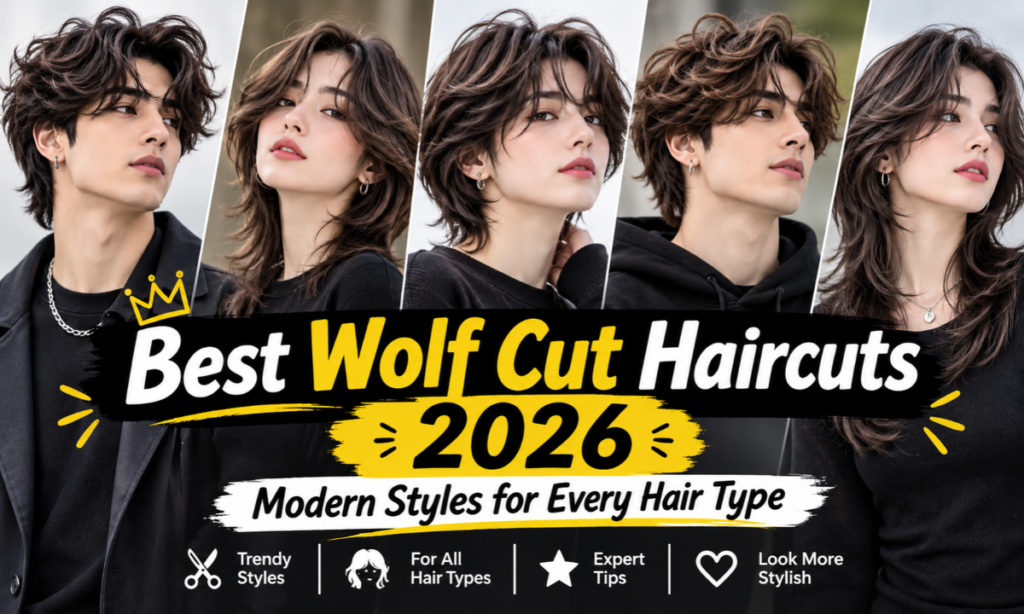
The wolf cut is still one of the most requested haircuts this year, and it has grown up. The 2026 wolf cut is softer, more blended and far easier to live with than the choppy, heavily teased version that went viral a few years ago. It keeps the volume at the crown and the wispy, lived-in ends, but it no longer demands an hour of styling every morning.
If you are searching for the best wolf cut haircuts for 2026, you are in the right place. This guide walks you through what a wolf cut really is, why wolf cut haircuts keep coming back, which style suits your face shape and hair type, and exactly what to tell your stylist so you leave the salon with the cut you imagined. You will also find styling routines, maintenance tips and the mistakes that ruin an otherwise great wolf cut.
Whether your hair is short, medium or long, straight, wavy or curly, there is a version of the wolf cut that works for you. Let’s find yours.
Preview a Wolf Cut Before You Ask for Shaggy Layers

A wolf cut is a big change. The shortest layers sit around your crown and cheekbones, and once they are cut, you cannot glue them back on. That is why the smartest first step is to preview the look before you book.
Most hair try-on apps let you upload a selfie and test short, medium and long wolf cut haircuts in seconds. Treat the result as a rough guide, not a promise. A filter cannot know how your cowlick behaves or how thick your hair really is, but it can tell you whether the shape of the cut suits your face.
Here is a simple preview routine that takes about ten minutes:
- Save three to five photos of wolf cuts on people who share your hair texture. A photo of fine, straight hair will not help a stylist who is cutting thick curls.
- Try two or three different lengths in a virtual try-on tool.
- Pay attention to where the shortest layer lands. Cheekbone, jaw and collarbone each create a very different effect.
- Decide whether you want bangs, and what kind: curtain, wispy, blunt or none.
- Bring your favorite two images to the consultation and explain what you like about each one.
Your reference pictures matter more than any technical term. A stylist can read a photo faster than a paragraph.
Key Takeaways
- A wolf cut blends a shag (lots of layers) with a mullet (shorter top, longer back).
- The 2026 wolf cut uses softer, more blended layers than earlier versions, so it looks polished without looking stiff.
- Your face shape decides where the shortest layers and the bangs should sit.
- Hair texture matters more than the trend. Waves and curls carry a wolf cut naturally, while fine or straight hair needs smart layering and a little product.
- Plan a trim every six to eight weeks to keep the shape from turning into a grown-out mess.
- Show photos and describe the finish you want. The name “wolf cut” means something different to every stylist.
- The best wolf cut is the one that fits your hair, your routine and your confidence level, not the most dramatic one on your feed.
What Makes a Wolf Cut Different?

A wolf cut is a heavily layered haircut with short, textured layers on top and longer, thinner lengths at the back. Think of it as a shag and a mullet merged into one shape. The top is rounded and full. The sides frame the face. The back tapers into wispy, uneven ends.
A regular layered cut moves gradually from short to long. A wolf cut has a clearer jump: a fluffy, voluminous crown and a lighter tail. That contrast is what gives the wolf cut its signature movement and its slightly rebellious personality.
Wolf Cut vs Shag vs Mullet vs Regular Layers
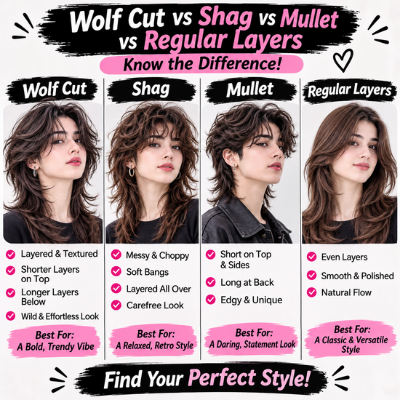
People mix these cuts up all the time, so here is a quick comparison.
| Feature | Wolf Cut | Shag | Mullet | Regular Layers |
| Top layers | Short, textured | Short to medium | Very short | Medium |
| Back length | Long, wispy | Medium, feathered | Long, often blunt | Even, gradual |
| Volume | High at the crown | High all over | Moderate | Low to moderate |
| Bangs | Often curtain or shaggy | Often | Sometimes | Optional |
| Contrast between top and back | Noticeable but blended | Soft | Strong | Minimal |
| Styling effort | Low to medium | Medium | Low | Low |
If you want the volume of a shag and the length of a long haircut, the wolf cut is the middle ground. If you want something softer than a mullet, the wolf cut is the safer choice.
The Main Parts of a Wolf Cut
Every wolf cut, no matter the length, is built from the same four elements:
- Crown layers: short layers on the top of the head that create lift and a rounded shape.
- Face-framing pieces: shorter strands around the cheeks and jaw, often paired with curtain bangs.
- Textured ends: point-cut or razored tips that look airy instead of blunt.
- A longer back section: the “tail” that keeps the cut from looking like a short crop.
When a stylist adjusts the length, the angle of the layers or the type of bangs, they are changing these four parts to suit you.
Why Wolf Cut Haircuts Are Trending in 2026

The wolf cut first exploded on social media, but it has stayed popular because people can actually wear it. A haircut does not last this long on looks alone. It has to work in real life.
Three reasons explain the staying power.
1. It looks styled even when it is not. Air-dried texture is the whole point of a wolf cut, so a messy morning still looks intentional. That is a huge relief if you do not want a long routine.
2. It adds volume without much effort. Short crown layers lift flat hair and remove weight from thick hair. Both problems get solved with one cut.
3. It adapts to almost anyone. Stylists now soften the shape with Korean-inspired layers, curtain bangs and gentle face framing, so the same base cut can look edgy, romantic or office-friendly depending on how you style it.
The trend has also moved beyond gender labels. Wolf cut hairstyles for men and women use the same layered structure. The differences come from length, bangs and how the ends are finished.
What Changed From the Original Wolf Cut?
The early version leaned hard on contrast: very short top layers and a long, thin tail. In 2026 the look is more refined.
- Layers blend into each other instead of stopping abruptly.
- Bangs are usually wispy or curtain-style instead of heavy.
- The tail is lighter and less stringy.
- Color is more natural, with soft dimension instead of bold contrast.
In short, the modern wolf cut keeps the attitude and drops the harshness.
Should You Get a Wolf Cut?
Before you commit, be honest about your lifestyle and your hair. A wolf cut is easy for some people and annoying for others.
A Wolf Cut Is a Good Fit If You
- Want more shape and movement without losing all your length
- Have wavy, curly or thick hair that feels heavy
- Like a relaxed, undone finish
- Are happy to visit the salon every couple of months
- Enjoy experimenting with texture spray, mousse or a diffuser
Think Twice If You
- Prefer a sleek, polished, one-length look every day
- Have very fine, flat hair and refuse to use any texturizing product
- Are growing your hair out to a single even length
- Need a very formal hairstyle for work every day (a soft version can still work, but talk to your stylist)
- Hate the awkward stage that follows when layers grow out
A wolf cut rewards people who accept a little mess. If that sounds like you, keep reading.
Wolf Cuts by Face Shape
The best wolf cut haircuts follow your face shape. The shortest layer, the bang style and the overall length all change how your face reads. Use the table below as a starting point, then let your stylist adjust it to your features.
| Face Shape | Best Wolf Cut Style | Why It Works |
| Round | Long wolf cut with side-swept bangs | Length and diagonal layers visually elongate the face |
| Oval | Almost any wolf cut | Balanced proportions suit most layer patterns |
| Square | Soft wolf layers with curtain bangs | Wispy layers soften a strong jawline |
| Heart | Medium wolf cut with chin-length face framing | Adds fullness near the jaw to balance a wider forehead |
| Long | Short-to-medium wolf cut with a fringe | Bangs and side volume shorten the look of the face |
| Diamond | Layered wolf cut with cheekbone-length pieces | Highlights cheekbones without adding width there |
Wolf Cut for a Round Face
Round faces look best with length. Ask for the shortest layers to start below the chin so the cut draws the eye downward. Side-swept or long curtain bangs add diagonal lines that make the face look longer. Avoid very short, heavy layers at the cheeks, because they can add width exactly where you do not want it.
Wolf Cut for an Oval Face
Oval faces are the most flexible. You can try a short wolf cut, a long one or a bold version with blunt bangs. The only real rule is to keep the proportions balanced. If you are unsure, start with medium length and adjust later.
Wolf Cut for a Square Face
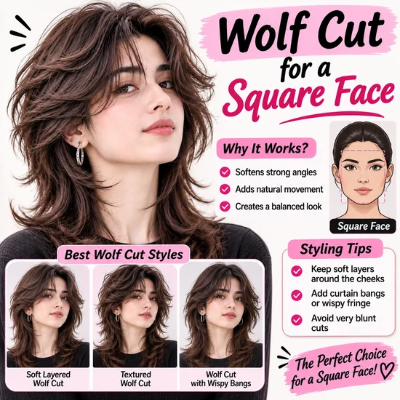
A strong jaw looks beautiful with softness around it. Choose feathery, face-framing layers that land just below the jawline, and add curtain bangs to break up the forehead. Skip sharp, blunt layers that echo the angles of the jaw.
Wolf Cut for a Heart-Shaped Face
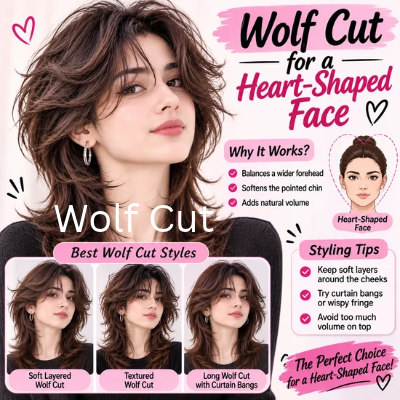
Heart-shaped faces carry width at the forehead and a narrower chin. A medium wolf cut with fuller layers around the jaw balances that shape. Side-parted wispy bangs work well, while very heavy, straight-across bangs can make the forehead look wider.
Wolf Cut for a Long Face
Long faces benefit from width and a fringe. A short or medium wolf cut with bangs reduces the vertical look, and wavy texture at the sides adds balance. Avoid piling all the height on top of the head, because it makes the face look even longer.
Wolf Cut for a Diamond Face
Diamond faces have prominent cheekbones. Layers that start at the cheekbone and fall past it highlight that feature without exaggerating it. Soft curtain bangs and a bit of volume at the forehead and jaw keep everything in proportion.
Hair Texture Matters More Than the Trend
This is the part most inspiration galleries skip. A wolf cut on curly hair and a wolf cut on straight hair are two completely different haircuts. The same set of scissors cannot give the same result, because curls shrink, waves bend and straight hair shows every line.
Here is how the wolf cut behaves on each hair type, and what to ask for.
Wolf Cut for Straight Hair
Straight hair shows every layer line, which can make a wolf cut look stepped and heavy. The fix is texture. Ask your stylist for point cutting or razor texturizing so the transitions blur and the ends look feathered.
Straight hair also lets you play with shape. A sleek, long wolf cut with soft face framing looks modern and polished. For more edge, add a blunt fringe. A light texture spray or sea salt spray on dry hair gives the layers some grip and keeps them from lying flat.
Wolf Cut for Wavy Hair
Wavy hair is the easiest to cut and style. Waves naturally separate into pieces, so the layers look dimensional with almost no effort. A medium or long wolf cut on wavy hair often looks great after nothing more than scrunching in a bit of mousse and air-drying.
Ask for layers that follow the wave pattern instead of fighting it. If your waves bunch up at one length, tell the stylist so they can avoid creating a stubborn shelf there.
Wolf Cut for Curly Hair
Curly hair and the wolf cut are a natural pair, because the shape comes close to a curly shag. The layers reduce the triangle effect (narrow at the top, wide at the bottom) and let curls stack into a rounded silhouette.
The key is cutting curls dry or one curl at a time, so the stylist sees the real length and shape. Curls bounce up when cut, so a layer that looks right when wet may end up much shorter once it dries. Tell your stylist to leave extra length.
Wolf Cut for Coily and Afro-Textured Hair
Coily hair holds shape beautifully, which makes a wolf cut dramatic and sculpted. Layers create a rounded crown, and the longer back adds contrast. Choose a stylist who has experience cutting coily textures, because shrinkage is significant and the layering has to be planned around it.
Moisture matters here. Defined coils with a leave-in conditioner and a curl cream look healthier than dry, frizzy layers, and the cut will show every bit of that difference.
Wolf Cut for Fine or Thin Hair
Fine hair can wear a wolf cut, but it needs a careful approach. Too many short layers can make thin hair look see-through, especially at the ends. Ask for fewer layers, concentrate them around the crown and face, and keep the back a little fuller.
A volumizing mousse, a root-lifting spray and a quick blow-dry with a round brush help the cut look full. If your hair is very fine, a medium wolf cut is often safer than a long one.
Wolf Cut for Thick Hair
Thick hair is where the wolf cut shines. Layers remove bulk and give heavy hair movement it did not have before. Ask for internal layers or thinning, so the weight lifts out of the middle of your hair without leaving the ends scraggly.
Thick hair can look puffy if the layers are too short at the top. A long wolf cut with soft crown layers keeps the volume under control and still gives you the shape.
Best Wolf Cut Styles for Every Hair Type
Now that you know how texture and face shape guide the cut, here are the best wolf cut styles for 2026. Each one is described by length, vibe and the hair type it flatters most, so you can match it to your own head instead of copying a photo blindly.
| Style | Best For | Hair Type | Effort Level |
| Short wolf cut | Bold, low-maintenance looks | Wavy, thick, curly | Low |
| Medium wolf cut | Balanced everyday wear | Almost all textures | Low to medium |
| Long wolf cut | Keeping length and adding movement | Straight, wavy, thick | Medium |
| Wolf cut mullet | Edgy, high-contrast shape | Thick, wavy, coily | Medium |
| Soft wolf layers | Gentle, polished finish | Fine, straight, wavy | Low |
| Curly wolf cut (curly shag) | Defined curls with volume | Curly, coily | Medium |
| Korean wolf cut | Airy, wispy, face-framing look | Straight, fine, wavy | Medium |
Short, Medium & Long Wolf Cut Ideas
Length changes the personality of a wolf cut more than any other detail. A short wolf cut feels punky and playful. A medium wolf cut feels balanced and easy. A long wolf cut feels dramatic and romantic. Pick the length that matches how much hair you are willing to commit to, and how much time you have to style it.
Short Wolf Cut Ideas
The short wolf cut sits around the chin or jaw at the longest point, with a textured crown and a slightly longer nape. It is the most daring version, and it works best on people who like a bold change.
Fluffy short wolf cut. Soft, feathered layers create a cloud of volume around the head. This style loves thick, naturally wavy hair, because the texture does most of the styling for you. A little mousse and a quick scrunch is often enough.
Short wolf cut with curtain bangs. Curtain bangs open at the center and blend into the side layers. They frame the eyes and cheekbones and make the short length feel soft instead of severe.
Pixie-inspired wolf cut. Very short sides and back with longer, tousled layers on top. It keeps the shaggy attitude of a wolf cut but takes less time to style than any other version.
Short curly wolf cut. Curls stack into a rounded shape with short layers on top and slightly longer curls at the nape. It is playful, full of volume and works with your natural texture.
Short wolf cut haircuts need more frequent trims, usually every five to six weeks, because the shape disappears quickly as the layers grow.
Medium Wolf Cut Ideas
A medium wolf cut lands between the chin and the collarbone. It is the easiest length to wear and the one stylists recommend most often for first-timers. It adds shape without making you feel like you cut off everything.
Classic medium wolf cut. Rounded crown layers, face-framing pieces and a lightly textured tail. This version suits most face shapes and almost every hair type, and it looks good both air-dried and styled.
Medium wolf cut with wispy bangs. Thin, see-through bangs add softness and brush across the forehead. They are an easy way to try a fringe without a heavy commitment.
Layered medium wolf cut for fine hair. Fewer, longer layers keep the ends looking full. The crown layers still lift the roots, and the cut avoids the thin, stringy look that too many short layers can cause.
Shaggy medium wolf cut. More dramatic layers, more texture and a messier finish. This is the style to choose if you want people to notice the cut at first glance.
A medium wolf cut also grows out more gracefully than a short one. If you are nervous, start here.
Long Wolf Cut Ideas
A long wolf cut keeps your length and still delivers volume and movement. The shortest layers start around the cheekbones or jaw, and the back falls past the shoulders. It is the most popular choice for people who do not want to part with their length.
Classic long wolf cut. Short crown layers, face framing and a long, wispy tail. It is dramatic, a bit vintage and very photogenic.
Long wolf cut with curtain bangs. The bangs blend into the longer layers, so the whole cut flows together. This version feels softer and more romantic.
Long choppy wolf cut. Razor-cut layers create a piecey, uneven finish. It suits thick, straight hair that needs a lot of movement.
Long layered wolf cut with waves. Loose waves enhance the layers and show off the cut’s dimension. Use a curling iron or a few braids overnight for an easy wavy finish.
Long wolf cut on curly hair. Curls display the layered structure beautifully, and the length makes the style feel full and dramatic. Moisture and curl-defining products keep it healthy.
The tradeoff with long wolf cut haircuts is that the thin tail can look stringy if the ends are not cared for. Regular trims and a good conditioner make a big difference.
Try on a Wolf Cut Mullet
The wolf cut mullet is the most dramatic cousin in the family. It keeps the rounded shaggy top, but the back is noticeably longer and the contrast is stronger. Think of it as a wolf cut with the volume turned up.
Who it suits: people with thick or wavy hair, a confident personality and a willingness to style a bit. It also works well on coily hair, where the structure holds its shape without effort.
How to make it wearable in 2026:
- Blend the transition between the top and the tail so it looks like a gradient, not a step.
- Keep the tail thin and textured instead of blunt.
- Add soft face-framing layers so the cut feels feminine or relaxed, depending on your style.
- Try a fade or soft tapering at the sides if you want an edgier look.
Before you commit, preview the wolf cut mullet in a try-on app. It is the style where seeing the shape matters most, because the contrast is hard to imagine.
Try Softer Wolf Layers
If the classic wolf cut feels like too much, soft wolf layers are the gentle version. The idea is simple: keep the volume at the crown and the movement at the ends, but blend every layer so nothing looks abrupt.
Soft wolf layers are ideal for:
- Fine or thin hair that cannot handle heavy layering
- People who need a more polished look for work
- Anyone growing out a bob or a blunt cut
- Hair that is straight and needs a little movement
To get the look, ask for long, blended layers with a rounded top and subtle face framing. Skip razor-heavy texturizing, because it can make fine hair look sparse. Finish with a lightweight mousse and a gentle blow-dry.
Soft wolf layers also grow out beautifully. If you want a haircut that still looks good in three months, this is the one.
Try a Curly Shag
The curly shag is the wolf cut’s closest relative, and on curls it is often the best version of the trend. Layers remove the heavy bottom weight, so curls bounce upward instead of sprawling outward. The result is a rounded, full shape with lots of definition.
Tips for getting a curly shag right:
- Cut your curls dry or ask the stylist to cut them curl by curl.
- Leave extra length, because curls spring up after cutting.
- Ask for layers that follow your natural curl pattern.
- Keep the front pieces slightly longer for a soft frame.
- Use a diffuser on low heat, or air-dry with curl cream and a gel.
A curly wolf cut should always look intentional, not unkempt. Moisture, a good curl cream and a silk pillowcase help the layers hold their shape between washes.
Korean Wolf Cut
The Korean wolf cut is one of the biggest versions of the trend in 2026. It leans on airy layers, wispy bangs and a lighter, more feminine finish. The layers are cut to move with the head and reveal a soft S-curve at the ends.
What sets it apart:
- Lighter layers: less dramatic contrast between the top and the back.
- Wispy see-through bangs: thin and soft instead of heavy.
- Face framing: long, soft pieces that sweep past the cheeks.
- Smooth, glossy finish: often styled with a slight inward or outward curl.
It works best on straight or slightly wavy hair, and it is flattering for people with fine hair who want body without heaviness. Ask for “airy layers with thin bangs” and bring a reference photo, because the term varies from salon to salon.
Wolf Cut With Bangs
Bangs change the entire feel of a wolf cut. The right fringe softens the face, hides a high forehead and adds even more personality. The wrong one can add maintenance you did not want.
| Bang Style | Look | Best For | Maintenance |
| Curtain bangs | Soft, parted in the middle | Most face shapes | Low |
| Wispy bangs | Light and see-through | Fine hair, round faces | Low to medium |
| Blunt bangs | Strong, graphic | Straight, thick hair | High |
| Side-swept bangs | Diagonal and flattering | Round and square faces | Low |
| Shaggy bangs | Choppy, textured | Wavy and curly hair | Medium |
| No bangs | Face-framing layers only | Anyone who dislikes fringes | Lowest |
If you are unsure, start with curtain bangs. They grow out easily and blend into your layers within a few weeks.
Wolf Cut for Men
The wolf cut for men follows the same layered structure, but the length, the bangs and the finish are adjusted for a more masculine look. Short, medium and long versions all exist, and each one is easy to personalize.
Short wolf cut for men. A shaggy top with tapered sides and a slightly longer back. It is easy to maintain and looks great with texture paste.
Medium wolf cut for men. Layers fall to the ears or jaw, with a messy fringe and a lightly textured tail. It works well on wavy hair.
Long wolf cut for men. Shoulder-length layers with a full crown and loose waves. Use sea salt spray for a beachy, undone finish.
Curly wolf cut for men. Curls get a rounded shape with volume on top and tapered sides. A curl cream and a light finger-styling session keep it neat.
Men with fine or thinning hair should ask for a shorter, textured wolf cut with a fade at the sides. It adds fullness at the top without drawing attention to the hairline.
Wolf Cut Colors and Highlights
Color can make a wolf cut look even better, because layered hair shows off dimension. The best colors in 2026 are natural, soft and slightly lived-in.
- Natural brunette with face-framing highlights: brightens the face and highlights the layers.
- Soft blonde balayage: adds light to the ends without a harsh line.
- Copper and auburn tones: warm, rich and very visible on textured layers.
- Dark chocolate or black: sleek, bold and especially striking on a wolf mullet.
- Money-piece highlights: bright strands around the face give an instant lift.
If you color your hair, remember that wolf cut ends are thin and delicate. Bleaching them heavily can make them look frayed. Use a bond-building treatment and ask your colorist to keep the lightest tones around the face rather than through the whole tail.
Wolf Cut for Women Over 40 and 50
The wolf cut is not just for twenty-somethings. Many stylists recommend a soft, medium-length wolf cut for women over 40 and 50, because the layers add lift at the crown and frame the face gently.
What works best:
- A medium length, usually between the chin and collarbone.
- Soft, blended layers instead of choppy, razored ones.
- Curtain or side-swept bangs to soften the forehead.
- Gloss treatments or a soft color to make the layers shine.
If your hair is thinning or fine, ask for fewer layers and more focus around the crown. A smart wolf cut can make thin hair look fuller and younger without trying too hard.
What to Ask Your Stylist For
The fastest way to get a bad wolf cut is to walk in and say, “Give me a wolf cut.” The name covers a huge range of looks, and your stylist will fill in the blanks with their own taste. Be specific.
Your Consultation Checklist
- Show two or three photos of wolf cut haircuts on hair like yours, and say what you like about each one: the length, the bangs, the volume or the texture.
- Tell them your length limit. For example, “I do not want anything shorter than my collarbone at the back.”
- Describe your daily routine. If you only have five minutes in the morning, say so. A good stylist will adjust the cut to your habits.
- Mention your texture honestly. Talk about your natural waves, cowlicks, thin patches and where your hair tends to puff up.
- Decide on bangs. Choose curtain, wispy, blunt or none, and be clear about how long you are willing to wait for them to grow if you change your mind.
- Ask how the cut will grow out. A good wolf cut should still look decent at week eight.
- Ask for a styling demo. Have the stylist show you which products and tools they used, so you can repeat it at home.
Phrases That Help
These phrases make it easier for a stylist to understand what you want:
- “Soft, blended layers instead of choppy ones.”
- “Keep the tail thin but not stringy.”
- “I want volume at the crown but not too much at the cheeks.”
- “Start the shortest layer at my cheekbone.”
- “Please texturize the ends with point cutting instead of a razor.”
- “Leave a bit of extra length, because my hair shrinks when it dries.”
Questions to Ask Before the First Snip
- How many layers will this involve, and where will the shortest one sit?
- Will you cut my hair wet or dry?
- How often will I need a trim to keep the shape?
- What can I do if I decide I want to grow the layers out?
A stylist who answers these questions clearly is usually a stylist you can trust with scissors.
How to Style and Maintain a Wolf Cut
The wolf cut is built to look relaxed, so the best styling routines are short and flexible. You do not need hot tools every day, but a few well-chosen products and techniques make the difference between “effortless” and “unfinished.”
Everyday Styling Routine for a Wolf Cut
Here is a simple routine that works on most hair types.
- Wash and condition. Use a lightweight shampoo if your hair is fine, and a richer conditioner if it is thick or curly.
- Apply a leave-in or primer to damp hair. It protects the ends and gives the layers a smooth base.
- Add the right product. Use mousse for fine and straight hair, curl cream for waves and curls, and sea salt spray for a beachy texture.
- Dry the crown first. Lift the roots with your fingers or a round brush to build volume at the top.
- Let the rest air-dry or diffuse. Waves and curls look best with minimal handling.
- Finish with texture. A dry texture spray or a tiny bit of paste on the ends separates the layers.
- Shake it out. Mess it up a little with your fingers. A wolf cut looks best when it is not perfect.
How to Style a Wolf Cut by Hair Type
| Hair Type | Best Products | Best Technique | Finish |
| Straight | Texture spray, light mousse | Blow-dry roots upward, loose waves with iron | Feathery, voluminous |
| Wavy | Mousse, sea salt spray | Scrunch and air-dry or diffuse | Natural, tousled |
| Curly | Curl cream, gel | Diffuse on low heat, scrunch out the crunch | Defined, bouncy |
| Coily | Leave-in, curl cream, oil | Finger coil or shake out, pick at the crown | Full, rounded |
| Fine | Volumizing mousse, root spray | Blow-dry upside down | Fuller, lifted |
| Thick | Smoothing cream, light oil | Diffuse or air-dry | Controlled, airy |
Styling the Bangs
Bangs make or break a wolf cut, so give them a little attention.
- Curtain bangs: blow-dry with a medium round brush, pulling the hair away from the center and slightly outward.
- Wispy bangs: use a tiny amount of dry shampoo at the roots to prevent oiliness, because thin bangs get greasy fast.
- Blunt bangs: wash them separately in the sink if you have a busy day. It takes two minutes and keeps them fresh.
Heat Styling Without Damage
The thin ends of a wolf cut are delicate. If you use a curling iron or flat iron, keep the temperature as low as works for your hair, and always apply a heat protectant first. Curl away from the face for a looser look, and let the curls cool before brushing them out with your fingers.
If you want curls without heat, try sleeping in two loose braids or a soft twist. In the morning, shake the waves out and add a little texture spray.
The Maintenance Question
This is the question people ask last and regret not asking first: how much work is a wolf cut, really?
The honest answer is that it is low effort for daily styling and moderate effort for upkeep. You can get out of bed and go, but you do need regular trims to keep the shape.
How Often to Trim
| Length | Trim Frequency | Why |
| Short wolf cut | Every 5 to 6 weeks | Short layers lose shape quickly |
| Medium wolf cut | Every 6 to 8 weeks | Layers need refreshing but grow out gracefully |
| Long wolf cut | Every 8 to 10 weeks | Ends thin out and need a tidy |
| Wolf cut with bangs | Bangs every 3 to 4 weeks | Fringes grow into the eyes fast |
You can trim your bangs at home if you are careful, but ask your stylist to show you how, or book a quick fringe trim. Most salons do these for little or nothing.
Daily Upkeep Tips
- Use a silk or satin pillowcase to reduce frizz and tangles, especially for curly and long wolf cuts.
- Detangle gently from the ends upward with a wide-tooth comb.
- Deep condition once a week, because layered ends dry out quickly.
- Use a gentle clarifying shampoo once or twice a month to remove product buildup, which weighs down layers.
- Protect your ends from sun and heat, especially if they are color-treated.
Product Basics for a Wolf Cut
You do not need a bathroom shelf full of products. A small, smart kit does the job.
- Mousse or volumizing foam: adds lift and body for fine or straight hair.
- Sea salt or texture spray: creates a tousled, beachy finish.
- Curl cream or gel: defines waves and curls.
- Leave-in conditioner: protects and smooths the ends.
- Heat protectant: essential if you use hot tools.
- Dry shampoo: refreshes the roots and adds grip to the crown.
Growing Out a Wolf Cut
Every haircut has a growing-out stage, and the wolf cut is no exception. The crown layers become shaggy, and the tail starts to blend in. Here is how to manage it.
- Get a trim every eight to ten weeks to keep the shape balanced.
- Ask your stylist to blend the layers gradually, instead of cutting them all off.
- Use headbands, clips and half-up styles when the layers feel awkward.
- Be patient, because the shortest layers need about four to six months to catch up with the rest.
Common Wolf Cut Mistakes
A wolf cut is forgiving when it is done well and frustrating when it is not. These are the mistakes that cause most wolf cut regrets, and how to avoid each one.
1. Asking for the Same Cut as Your Photo
A reference photo is a guide, not a guarantee. Different hair density, texture and growth patterns will always change the result. Pick a photo of someone with similar hair, and be flexible about the details.
2. Ignoring Your Hair Texture
This is the number one mistake. A cut designed for straight hair will not behave the same on curls, and the reverse is true too. Always choose a wolf cut that suits your natural pattern.
3. Too Many Short Layers on Fine Hair
Short layers on thin hair remove density and make the ends look see-through. Ask for fewer, longer layers and focus on the crown instead.
4. Cutting Curls Wet and Flat
Wet curls stretch out, so a layer that looks right when wet may sit much higher once dry. Curly hair should be cut dry or by a stylist who understands shrinkage.
5. Skipping Trims
A wolf cut relies on its shape. Without trims, the layers grow out unevenly, and the cut looks messy instead of intentional.
6. Over-Styling
The best wolf cut is not perfect. If you blow-dry, curl and spray every strand until nothing moves, you lose the relaxed, lived-in effect that makes the style special.
7. Skipping Bangs Advice
Bangs that do not suit your forehead or hairline can be annoying for months. Talk to your stylist about cowlicks and growth patterns before you decide.
8. Forgetting About Color Damage
Bleaching layered ends can leave them fragile and frayed. If you want a lighter shade, use bond-building treatments and plan color around your trim schedule.
9. Using Heavy Products
Thick creams and oils weigh down thin, wispy ends. Use lightweight products and apply them to the mid-lengths and ends, not the roots.
10. Not Telling the Stylist Your Routine
If you never use a hair dryer, say so. A good stylist will design the cut to work with your habits, not against them.
Is a Wolf Cut the Right Hairstyle for You?
Here is a quick self-check. Count how many of these statements sound like you.
- I like texture and movement more than sleek, perfect hair.
- I am comfortable with a slightly messy look.
- I can spend a few minutes styling each morning.
- I am happy to trim my hair every two months.
- I want volume or shape, or I have hair that feels flat or heavy.
- I like the idea of changing the look with bangs, color or styling.
If you agree with four or more, a wolf cut is likely a great match. If you agree with two or fewer, consider a softer option such as long layers, a shag or a blunt cut with light face framing.
Wolf Cut vs Other Popular Haircuts
| Haircut | Best If You Want | Maintenance |
| Wolf cut | Volume, edge and movement | Medium |
| Shag | Soft layers all over | Medium |
| Long layers | Gentle shape and length | Low |
| Bob | Clean, structured look | Medium to high |
| Butterfly cut | Face-framing and bounce | Medium |
| Curtain bangs with layers | Soft, easy upgrade | Low |
If you are still not sure, start with a medium wolf cut with soft layers and curtain bangs. It is the easiest to adjust, and the easiest to grow out if you change your mind.
Frequently Asked Questions About Wolf Cut Haircuts
What is a wolf cut?
A wolf cut is a layered haircut that blends a shag and a mullet, with short, textured layers on top and longer, wispy lengths at the back. It creates volume at the crown and movement at the ends.
Is the wolf cut still in style in 2026?
Yes. In 2026 the wolf cut is still popular, but the look is softer and more blended than the original viral version.
What hair type is best for a wolf cut?
Wavy, curly and thick hair carry a wolf cut most naturally. Straight and fine hair can also work with careful layering and texturizing products.
Does a wolf cut work on straight hair?
Yes. Ask for point cutting or razor texturizing to blur the layers, and use a light texture spray to add movement.
Does a wolf cut work on fine or thin hair?
It can. Choose fewer, longer layers concentrated around the crown, and avoid very short, heavy layering.
Is a wolf cut good for curly hair?
Yes. A curly wolf cut, also called a curly shag, removes weight and gives curls a rounded, bouncy shape.
What face shape suits a wolf cut best?
Oval faces suit almost any wolf cut, but every face shape works with the right length and bangs. Round faces do well with long wolf cuts, and square faces with soft layers.
How long does hair need to be for a wolf cut?
Most stylists suggest at least chin-length hair. Short wolf cuts are possible, but longer hair gives you more layering options.
How often should I trim a wolf cut?
Trim every six to eight weeks for most lengths. Bangs need a tidy every three to four weeks.
Is a wolf cut high maintenance?
Daily styling is easy, but regular trims are essential. Most people spend five to ten minutes styling it.
What is the difference between a wolf cut and a shag?
A shag has layers throughout, while a wolf cut has a stronger contrast between the short crown and the longer back. The wolf cut is essentially a shag with a mullet-inspired tail.
What is the difference between a wolf cut and a mullet?
A mullet has a stark difference between the top and the back, often with a blunt tail. A wolf cut blends the layers for a softer, more textured finish.
Can men get a wolf cut?
Yes. Wolf cut hairstyles for men use the same layered structure, adjusted for length, fringe and finish. Short, medium and long versions all work.
Can I get a wolf cut with bangs?
Yes. Curtain bangs, wispy bangs and shaggy bangs are the most popular, and they blend easily into the layers.
How do I grow out a wolf cut?
Get a trim every eight to ten weeks to blend the layers, and use clips or half-up styles while the short pieces catch up. It usually takes four to six months.
