


Thinking about the big chop? You are in good company. The best pixie haircuts 2026 has to offer are softer, more textured and far more wearable than the stiff crops of the past. Salons are seeing more requests for short hair than they have in years, and the trend is not slowing down.
This guide walks you through everything in one place. You will learn which pixie suits your face shape and hair texture, how often you will really need a trim, how to style it, and what to say to your stylist so you leave happy. If you have ever stared at a photo and wondered, “Could I actually pull that off?”, keep reading.
Preview a pixie cut on your own face
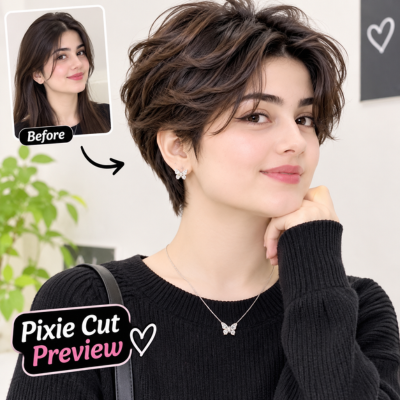
The hardest part of cutting your hair short is that you cannot undo it. A pixie takes months to grow out, so it makes sense to test the idea before you sit in the chair.
Here are three easy ways to preview the best pixie haircuts 2026 on your own face:
- Use a virtual try-on tool. Many free hair apps and websites let you upload a front-facing selfie and swap in different short styles. Pick a well-lit photo with your hair pulled back.
- Try a photo-edit trick. Pull your hair tightly back, tuck it under a scarf or swim cap, and look at your face with no hair around it. This shows your bone structure, ears, neckline and jaw clearly.
- Ask your stylist for a consultation. Many salons offer a short chat before any cutting. A good stylist will hold sections of your hair up to show how a shorter shape could sit.
A preview will not be perfect. Apps cannot judge your cowlicks, your hairline or how your hair behaves on a humid day. Still, it gives you a strong first impression and helps you decide between a micro crop and something softer.
Will a pixie cut suit me?
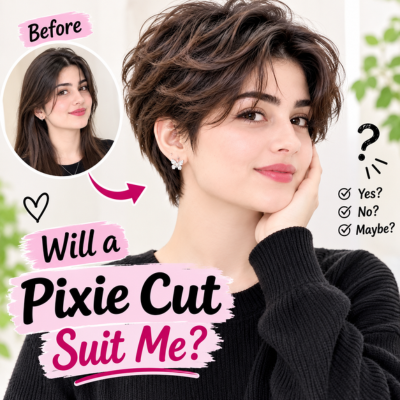
Almost certainly, yes, as long as you choose the right version. The old rule said pixies only work on small faces with delicate features. That idea has faded. Today’s stylists adjust the length on top, the shape of the fringe and the amount of texture to fit the person, not the other way around.
Ask yourself these five questions:
- Do I like my face and neck being on show? A pixie has no hair to hide behind. If that excites you, you are already halfway there.
- Can I spend 5 to 10 minutes styling each morning? Most pixies need a little product and a quick blow-dry.
- Will I book a trim every 4 to 6 weeks? Short hair loses its shape fast.
- Do I have any strong cowlicks or a low hairline? These can be worked with, but your stylist should know about them.
- Am I ready for a change, not a fix? A pixie works best when you want it, not when you are chasing a mood.
If you answered yes to most of these, a pixie is a strong option. If you are unsure, start with a longer pixie or a pixie-bob and go shorter next time.
Key takeaways
Short on time? Here is the quick version of this guide.
- The best pixie haircuts 2026 lean soft, textured and personal rather than sharp and uniform.
- Longer pixies, bixies (a pixie-bob blend), shaggy pixies and curly crops are among the most talked-about shapes this year.
- Face shape guides the fringe and top length, but personality and lifestyle matter just as much.
- Fine, thick, wavy and curly hair can all wear a pixie; each needs a different cutting plan.
- Expect a trim every 4 to 6 weeks to keep the shape clean.
- Styling takes minutes with a light cream, a pea-sized amount of paste or a texturizing spray.
- Bring photos, describe the finish you want and talk about daily routine with your stylist.
- If you are nervous, preview the cut first and begin with a slightly longer version.
Start with the version of pixie you mean
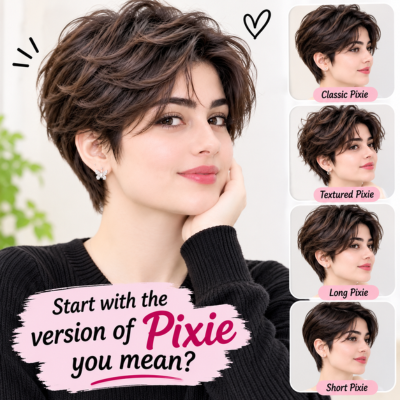
“Pixie” is a broad word. Ask ten people to describe one and you may get ten different haircuts. Before you book, get clear about which version you are after.
The classic pixie is short on the sides and back, with a little more length on top. It is neat, easy and timeless. Think of the crop made famous by Audrey Hepburn and Mia Farrow.
A modern pixie is looser. The top is cut with choppy layers, the edges are softened and the nape is often left a bit longer. This is the base for most of the best pixie haircuts 2026 lists you will see online.
Here is a quick comparison of the main types:
| Pixie type | Length on top | Sides and back | Best for | Vibe |
| Classic pixie | 1–2 inches | Tapered close | Fine to medium hair | Clean, polished |
| Soft textured pixie | 2–3 inches | Softly tapered | Most hair types | Easy, modern |
| Long pixie | 3–5 inches | Longer, blended | Those wary of going short | Relaxed, feminine |
| Pixie-bob (bixie) | 3–5 inches | Grazing the ears or jaw | Growing out a bob | Soft, flexible |
| Shaggy pixie | 2–4 inches, heavily layered | Piecey, uneven | Wavy or thick hair | Rock and roll |
| Micro pixie | Under 1 inch | Very close | Bold, confident looks | Dramatic, striking |
| Undercut pixie | 2–3 inches | Shaved or clipped short | Thick hair | Edgy, high contrast |
Once you know the type, you can search for photos with the right words. Searching “short pixie haircut” gives you wide results. Searching “soft textured pixie with side-swept fringe” gives you something your stylist can work from.
Pixie cuts by face shape
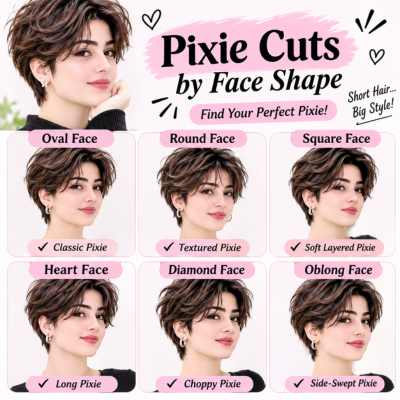
Face shape is a helpful starting point. It will not decide everything, but it points you toward flattering proportions. Look at your face in a mirror with your hair pulled back. Note where it is widest and how your jawline and forehead compare.
Oval face
Oval faces are balanced, so almost any pixie works. Try a classic crop, a micro pixie or a side-swept style. This is the face shape that can take the boldest versions of the best pixie haircuts 2026 without much adjusting.
Round face
The aim is to add height and length. Go for volume on top, a side part and tapered sides that slim the face. Avoid a heavy, blunt fringe straight across the forehead, which can make the face look wider.
Square face
Softness is your friend. Wispy, feathered layers and a side-swept fringe soften a strong jaw. A textured top with airy ends feels more flattering than a sharp, boxy outline.
Heart-shaped face
A wide forehead and a narrower chin call for balance. Side-swept bangs or a longer fringe cover part of the forehead. A bixie or a long pixie with a little length at the nape also helps the lower half of the face feel fuller.
Long or oblong face
Skip too much height on top. Instead, add width with soft fringe and fullness at the sides. A pixie-bob or a short crop with forward-swept bangs shortens the look of the face.
Diamond face
With high cheekbones and a narrower forehead and jaw, you can wear side-swept fringe with textured volume. This draws attention to your cheekbones and eyes.
Here is a handy summary:
| Face shape | Flattering pixie | What to avoid |
| Oval | Almost any style | Very little to avoid |
| Round | Tall top, side part, tapered sides | Heavy, blunt fringe |
| Square | Wispy layers, side-swept fringe | Sharp, boxy lines |
| Heart | Side bangs, bixie, long pixie | Very short nape with no softness |
| Long | Fringe, side volume, pixie-bob | Excess height on top |
| Diamond | Textured top, side-swept bangs | Extreme volume at cheekbones |
Treat the table as a guide, not a rulebook. Plenty of people break these rules and look wonderful. What matters is that the cut is tailored to you.
Hair texture changes the answer
Two people can ask for the same pixie and walk out with very different results. That is because hair texture shapes how a cut falls, lifts and holds.
Fine or thin hair
A pixie is one of the best ways to make fine hair look fuller. Shorter hair has less weight pulling it down, so it lifts more easily. Ask for soft layers on top and a slightly blunt edge at the perimeter. This creates the look of density.
- Use a volumizing mousse or root-lift spray on damp hair.
- Avoid heavy oils and rich creams that flatten the top.
- A bit of texturizing powder at the roots adds grip.
Thick hair
Thick hair can feel bulky when short, but a smart stylist will thin and shape it. Ask for internal layering or point-cutting so the pixie does not puff out. An undercut or tapered nape removes bulk and keeps the shape light.
- Use a smoothing balm to control frizz.
- Blow-dry with a nozzle to keep the hair sleek.
- Expect trims a little more often, since thick hair can grow into a shapeless mass.
Wavy hair
Waves look lovely in a pixie because they give you texture for free. Let a shaggy or layered cut work with your natural pattern. Scrunch in a light curl cream and let the hair dry naturally, or diffuse it for extra movement.
Curly and coily hair
Curly pixies are full of personality. The cut should be done with the curl pattern in mind, ideally by someone who is skilled with textured hair. Many curly clients do best with a dry cut or a cut on stretched hair so the stylist can see the final shape. We will look at this in more detail below.
Straight hair
Straight hair shows every line. This makes it great for crisp, graphic pixies, but also means imperfections in the cut show quickly. If you want texture, ask for choppy layers and use a paste or wax to create separation.
Here is a texture cheat sheet:
| Hair texture | Best pixie style | Key product |
| Fine | Soft layered pixie | Volumizing mousse |
| Thick | Tapered pixie or undercut | Smoothing balm |
| Wavy | Shaggy pixie | Curl cream or sea salt spray |
| Curly | Rounded curly crop | Curl-defining gel |
| Straight | Sleek, graphic crop | Paste or wax |
The maintenance question
People often say a pixie is “low-maintenance.” That is only half true. It is low-effort in the morning and higher-effort at the salon.
Salon visits
Most stylists recommend a trim every 4 to 6 weeks. Short hair shows regrowth quickly. The neckline, ears and fringe are the first areas to look untidy. A micro pixie may need a touch-up every 3 to 4 weeks, while a long pixie can stretch to 6 to 8 weeks.
Daily routine
A realistic morning routine looks like this:
- Wet or dampen your hair, or start with a quick shower.
- Towel-dry gently, then apply a small amount of styling product.
- Blow-dry using your fingers or a small brush to direct the top.
- Finish with a light dab of paste or a mist of flexible-hold spray.
That is usually under ten minutes. Many people find it much faster than styling longer hair.
Cost
Budget for the regular visits. Over a year, trims every five weeks add up. Factor this in, along with any colour appointments, before you commit to the best pixie haircuts 2026 has on offer.
Is it right for you?
A pixie suits you if you value fast mornings and enjoy a fresh, sharp shape. If you dislike frequent appointments, a longer pixie or a soft bixie is more forgiving.
Pixie cut ideas to test first
Now for the fun part. These are seven of the best pixie haircuts 2026 stylists are sharing. Each one includes who it suits, how it looks and what to ask for. Think of them as starting points. Your stylist can adapt any of them to your hair and face.
1. Soft textured pixie
The soft textured pixie is the easiest place to start. It has short, tapered sides and a top that is cut in uneven layers so it moves and catches the light. The edges are not harsh, which makes it flattering on most faces.
Best for: Most face shapes, fine to medium hair, first-time pixie wearers.
What to ask for: “A soft pixie with choppy layers on top, tapered sides and a longer, wispy fringe.”
How to style it: Use a dime-sized amount of paste, rub it between your palms and twist small sections upward. Scrunch gently and leave it a little messy.
Why it works in 2026: The look is relaxed and modern. It feels lived-in rather than perfect, and that effortless finish is exactly what people want right now.
Try on a textured pixie
Before booking, upload a photo to a virtual try-on and look at this cut with both a side-swept and a center-parted fringe. Notice how the layers frame your eyes and cheekbones. If the shape makes you smile, it is a good sign.
2. Long pixie
The long pixie is one of the biggest talking points among the best pixie haircuts 2026 lists. It keeps more length on top and at the nape, so you can still tuck hair behind your ears, sweep it to the side or push it back.
Best for: Anyone nervous about cutting too short, round or square faces, those with natural movement.
What to ask for: “A long pixie with textured layers, hair that grazes the ears and a lengthy side fringe.”
How to style it: A sea salt spray and a quick blow-dry give a tousled finish. Add a hint of shine serum on the ends for a polished evening look.
Pro tip: This is also a great bridge if you are growing out a bob or just starting your short-hair journey.
3. Pixie-bob
The pixie-bob, often called a “bixie,” blends a pixie with a bob. It is short at the nape and back, but long enough on top and around the ears to feel soft and feminine. Stylists love it because it behaves like a bob but feels fresh and daring.
Best for: Oval and heart-shaped faces, those who want flexibility, people moving from a bob to something shorter.
What to ask for: “A bixie with feathered layers, a graduated back and side-swept bangs.”
How to style it: Blow-dry with a round brush for body, then flick the ends slightly outward. You can tuck it behind one ear for a neat look.
4. Curly pixie
A curly pixie celebrates your natural pattern. When cut well, it creates a rounded, sculpted halo of curls that looks full and healthy. When cut badly, it can end up lopsided, so choose a stylist with experience.
Best for: Curly and coily textures, round or oval faces, anyone tired of heat styling.
What to ask for: “A rounded curly crop with shaping around the ears and nape, leaving enough length on top to keep the curl.”
How to style it:
- Apply a curl-defining cream to soaking wet hair.
- Rake it through with your fingers, then add a layer of gel.
- Scrunch upward and let it air-dry or diffuse on low heat.
- Once fully dry, gently break the cast and fluff with your fingers.
Try on a curly crop
If you want to preview this style, pick a photo that shows your natural curl pattern. Look for a try-on tool that handles textured hair well, since many default to straight styles. Even then, treat the result as a mood rather than a promise.
5. Side-swept pixie
The side-swept pixie is a classic that never goes away. Long strands at the front sweep across the forehead, while the sides and back stay short. It adds softness and can be worn smooth or messy.
Best for: Round, square and heart-shaped faces, anyone who wants a flattering fringe, people with a wide forehead.
What to ask for: “A pixie with a long, side-swept fringe, tapered sides and a wispy finish.”
How to style it: Part your hair deeply, brush the fringe across and set it with a bit of flexible hairspray. For a looser style, run your fingers through and let the pieces fall.
6. Micro pixie
The micro pixie is the boldest option. It is cut very close to the head, often less than an inch on top, and it puts your face front and center. It is dramatic, confident and wonderfully easy to wash and dry.
Best for: Oval faces, defined cheekbones, anyone with a strong sense of style.
What to ask for: “A cropped pixie with clipper-cut sides and a short, textured top. I want it neat and sharp.”
How to style it: Hardly any styling is needed. A pinch of lightweight pomade or wax gives definition. Many people accessorize with earrings, bold lipstick or sharp glasses to make the look pop.
Note: This cut needs trims every 3 to 4 weeks to stay crisp.
7. Color pixie
Short hair and color go hand in hand. A pixie shows off every shade, so even a small change feels dramatic. From icy blonde and copper to deep burgundy and cherry cola, color adds personality to the best pixie haircuts 2026 offers.
Best for: Anyone who loves experimenting, people with healthy hair, those who want a statement.
What to ask for: “A textured pixie with a subtle balayage, or a bold all-over shade with a shadow root.”
Color ideas to consider:
- Soft blonde: Light, bright and flattering on many skin tones.
- Rich copper: Warm and eye-catching, great for fair and medium skin.
- Cherry cola: A deep red with brown undertones, trendy this year.
- Silver or platinum: Cool, striking and chic.
- Chocolate brown: Glossy, classic and healthy-looking.
Try on a color pixie
Color try-ons are one of the most useful features of virtual tools. Swipe through shades before you commit. Remember that color results depend on your starting point, so ask your colorist what is realistic in one visit.
Pixie haircut trends shaping 2026
Pixie cuts have been called the comeback story of the decade. If the bob dominated recent years, short crops are now taking the spotlight. Stylists point to a few clear shifts that define the best pixie haircuts 2026 is known for.
Softness over sharpness
The stiff, gelled crop has given way to feathered edges, wispy fringes and a lived-in finish. The goal is movement. Hair should look like it has just been run through with your fingers, not locked in place.
The long pixie and the bixie
The long pixie, along with the bixie (a pixie-bob blend), is everywhere. These cuts feel more approachable than a crop, which is why so many first-timers choose them. They also grow out far more gracefully.
Shaggy and rock-inspired shapes
Pixie shags and “flixies” (a cross between a pixie and a flipped-out shag) bring heavy texture and choppy layers. They suit wavy hair especially well and give an undone, cool-girl feel.
Bold color and gloss
Short cuts are a perfect canvas for color. Deep cherry reds, buttery blondes and glossy browns are popular this year. Shine is key. A healthy-looking finish makes any pixie look expensive.
Individuality first
Stylists say the pixie renaissance is about personal expression. People are choosing cuts that suit their style, not copying one single look. That is why you will see micro crops, curly pixies and soft fringes all being called “trendy” at once.
| Trend | Key feature | Best hair type |
| Long pixie | Length at the nape and top | Straight to wavy |
| Bixie | Pixie-bob hybrid | Fine to medium |
| Flixie | Flipped, shaggy layers | Wavy, thick |
| Pixie shag | Heavy texture and choppy ends | Thick, wavy |
| Curly crop | Rounded, sculpted curls | Curly, coily |
| Color pixie | Statement shades | Healthy, virgin or colored |
How to style a short pixie haircut
One of the biggest joys of a pixie is how quickly it comes together. With the right tools and a few smart habits, you can create several looks from the same cut.
Gather your styling kit
You do not need a bathroom full of products. These basics cover almost every pixie:
- A lightweight mousse or root-lift spray for body on fine hair.
- A matte paste or clay for texture and separation.
- A smoothing cream or serum for shine and frizz control.
- A flexible-hold hairspray to set the shape without stiffness.
- A small round brush or paddle brush for blow-drying.
- A blow-dryer with a concentrator nozzle for precise control.
The everyday textured look
- Start with damp, towel-dried hair.
- Work a small amount of mousse or cream through from root to tip.
- Blow-dry upward and forward, using your fingers to lift the roots.
- Rub a pea-sized amount of paste between your fingertips.
- Twist and pinch sections on top to create piecey definition.
- Finish with a light mist of spray.
This takes about five to eight minutes and works for the soft textured pixie, the long pixie and the bixie.
The sleek and polished look
For work meetings or evening events, go smooth:
- Apply a smoothing balm to damp hair.
- Blow-dry with a paddle brush, directing hair to the side.
- Add a drop of shine serum to the palms and glide it over the top.
- Tuck one side behind your ear for a clean line.
A sleek pixie feels elegant, especially with statement earrings.
The messy, undone look
Sometimes the best style is no style at all. Let the cut air-dry, then scrunch in a bit of texturizing spray. Push your fingers through it and leave it. This is where a good cut does the work for you.
The edgy, gelled look
If you like drama, try a wet look. Apply a strong-hold gel to damp hair and comb it back or to the side. Let it dry naturally for a high-shine, runway finish.
Quick styling tips
- Less is more. Short hair shows product build-up quickly. Start small and add more if needed.
- Style the roots first. Volume starts at the root, so lift there before working on the ends.
- Use heat wisely. Short hair dries fast, so a medium setting is enough.
- Wash less if possible. Over-washing can leave hair limp, especially on fine strands. Dry shampoo helps between washes.
- Add accessories. A thin headband, hair clips or a silk scarf can dress up the cut instantly.
Pixie cuts with bangs
Bangs and a pixie are a natural pair. The fringe frames the face, hides a high forehead if you want and adds a point of style. Here are the most popular choices among the best pixie haircuts 2026 has to offer:
- Wispy bangs: Light and feathered, these suit most faces and need little effort.
- Side-swept bangs: Great for round, square and heart-shaped faces. They soften and elongate.
- Curtain bangs: Parted in the middle and swept to each side. They give a retro, soft finish.
- Blunt micro bangs: Short and bold, these are dramatic and stylish. They work best on oval faces.
- Long, face-framing fringe: Falls over the eyes slightly. It is moody, modern and very flattering.
Bangs need extra upkeep. Fringe can grow past the eyes in as little as two weeks, so ask your stylist whether they offer free quick fringe trims between full appointments.
Pixie cuts for different ages
A pixie is not age-specific. It can look youthful, sophisticated or playful depending on how it is cut and styled.
In your 20s and 30s
This is a great time to experiment. Micro pixies, undercuts and vivid colors all feel fun and fresh. Many people in this age group also use a pixie to simplify a busy morning routine.
In your 40s
A textured pixie with a longer fringe is a popular choice. It is easy to style, and the layered shape adds movement. Subtle highlights add brightness and dimension.
In your 50s and beyond
Hairdressers often recommend the bixie, flixie or a soft layered pixie for mature clients. The extra volume on top makes hair look thicker, while soft edges flatter the face. Silver and salt-and-pepper hair look particularly striking when cut short. Choose a good gloss treatment to keep the color luminous.
Celebrity inspiration worth saving
Celebrities have helped push short hair back into the spotlight. Names such as Teyana Taylor, Jessie Buckley, Gracie Abrams, Emma Stone and Kehlani have all been linked with pixie looks in recent seasons, from soft crops to shaggy cuts and bold colors.
When using celebrity photos as inspiration, remember:
- Check that the hair texture is similar to yours.
- Look at the photo from several angles, not just the front.
- Notice whether the hair was styled with heat, products or editing.
- Choose two or three photos that show what you like, then explain why.
Images are a tool, not a promise. Your stylist will adapt the idea to suit your face and hair.
Growing out a pixie cut
Sooner or later, you may want length again. Growing out a pixie takes patience, but it can be easy with the right plan.
What to expect
Hair grows roughly half an inch per month. Moving from a pixie to a chin-length bob can take 12 to 18 months. There is an awkward middle stage, but you can manage it.
A simple growing-out plan
- Stay on schedule with trims. Go every 8 to 10 weeks instead of every 4 to 6. This keeps the shape clean without removing too much length.
- Reshape the nape and ears. These areas get messy first. Ask your stylist to tidy them while leaving length on top.
- Use a bixie as a stepping stone. A pixie-bob blend gives you a flattering shape as the back catches up.
- Add layers. Soft layers stop the hair from looking heavy and shapeless.
- Care for your ends. Use a weekly mask and a light leave-in conditioner to prevent breakage.
- Style creatively. Headbands, clips, scarves and small braids at the front help when you hit the in-between phase.
Timeline at a glance
| Stage | Time | What to do |
| Short pixie | Months 0–2 | Keep the shape tidy |
| Growing pixie | Months 3–5 | Reshape nape and fringe |
| Pixie-bob | Months 6–9 | Add soft layers |
| Short bob | Months 10–14 | Trim every 8–10 weeks |
| Chin-length bob | Months 15–18 | Add shine and keep ends healthy |
Be kind to yourself during this stage. Every hair journey has an awkward chapter, and it passes.
What can go wrong with a pixie cut?
A pixie is a bold step, so it helps to know the common pitfalls before you start. Most are easy to avoid.
The cut is too short
You can always take more off, but you cannot put it back. If you are unsure, ask your stylist to begin longer and refine it. You can go shorter at the next visit.
Cowlicks and hair growth patterns
Crowns, whorls and cowlicks can make hair stick up in odd directions. A skilled stylist works with them instead of fighting them. Show your stylist the problem areas before they start cutting.
The wrong shape for your face
A pixie that ignores your features can feel off. Use the face-shape tips above to guide your choice, and listen to your stylist’s advice.
Ignoring your hair texture
A cut that suits straight hair may not suit curly hair. Choose a stylist with experience in your texture and ask to see examples of similar work.
Skipping maintenance
A pixie that is overdue for a trim can look shapeless. Book your next appointment before you leave the salon.
Unrealistic expectations
Social media photos are often heavily styled, edited or lit professionally. Your haircut may look different in real life. That does not mean it is wrong; it just means it is yours.
Too many products
Small amounts go a long way on short hair. Overdoing it leaves hair heavy, greasy or stiff.
Quick troubleshooting guide
| Problem | Likely cause | Easy fix |
| Hair looks flat | Too much product or heavy cream | Switch to mousse and lift at the roots |
| Sticking up at the crown | Natural whorl | Ask for a custom cut or style with a brush |
| Fringe in your eyes | Overdue for a trim | Book a quick fringe trim |
| Looks too boyish | Edges are too sharp | Ask for softer layers and a longer fringe |
| Hard to style | Wrong product | Try paste for texture, serum for smoothness |
Preview a pixie before the salon
Before you commit, take a few more steps to reduce the risk. A little preparation is the secret to loving the best pixie haircuts 2026 offers.
Build a mood board
Save five to ten photos of cuts you love. Look for patterns. Are most of them long pixies? Do they have side-swept fringes? A mood board helps you spot what appeals to you most.
Check the back and sides
Most pictures only show the front. Search for side and back views, since the nape and ears matter just as much.
Try temporary changes
Tuck your hair behind your ears, pin it back, or wear a short wig. This gives you a feel for how it is to have your face and neck exposed.
Pick the right stylist
Look at the stylist’s portfolio. Do they have photos of short cuts on hair like yours? Read reviews and ask for recommendations from friends with pixies.
Book a consultation
Most salons offer a free or low-cost chat before the haircut. Use it to ask questions, discuss maintenance and agree on a plan.
Pre-chop checklist
- I have photos from the front, side and back.
- I know my face shape and hair texture.
- I have a stylist I trust.
- I have time and budget for regular trims.
- I know what products I need.
- I am ready for a change.
What to tell your stylist
The consultation is where a good haircut begins. Clear communication stops misunderstandings and helps your stylist deliver the look you want.
Share your photos
Bring three to five reference images. Include at least one that shows the back or side. Point out the parts you like, such as the fringe, the length on top or the tapered nape.
Describe the finish you want
Words matter. Choose from terms like these:
- Soft or sharp? Do you want feathered edges or crisp lines?
- Textured or smooth? Do you want choppy layers or a sleek finish?
- Short or long? Say exactly how much length you want to keep on top and at the nape.
- Fringe or no fringe? Describe the style and length of the fringe.
Talk about your routine
Tell your stylist how much time you spend on your hair each morning. Mention the tools and products you use. If you prefer air-drying, say so. A great cut should suit your lifestyle.
Mention your hair history
Share any past coloring, chemical straightening, perms or damage. These affect how the hair behaves and which styles are realistic.
Point out problem areas
Cowlicks, thin patches, a receding hairline or a stubborn crown all affect the final shape. Pointing them out early lets your stylist plan around them.
Ask the right questions
Use these to guide the conversation:
- How often will I need a trim?
- Which products do you recommend for my hair?
- How will this cut look as it grows?
- Can you show me how to style it at home?
- Is there anything I should avoid?
Sample script
“I want a soft textured pixie with choppy layers on top, about two to three inches. Please keep the sides tapered but not too tight, and leave a longer, wispy fringe that I can sweep to the side. I have a cowlick at the crown and I usually spend five minutes on my hair. I would like to trim every six weeks.”
Communicating this clearly gives your stylist everything they need.
Pixie cut vs bob: which one should you choose?
If you are standing between a bob and a pixie, you are not alone. Both are chic, both are popular and both can look stunning. The right pick depends on your lifestyle and how brave you feel.
| Feature | Pixie cut | Bob |
| Length | Above the ears or nape | Chin to shoulder |
| Morning styling time | 5–10 minutes | 10–20 minutes |
| Trim frequency | Every 4–6 weeks | Every 6–10 weeks |
| Versatility | Fewer updos or ponytails | Can be tied back |
| Face and neck | Fully on show | Partly covered |
| Growing out | Longer, awkward stages | Simpler |
| Statement factor | High | Medium |
Choose a pixie if you want a bold, low-effort morning and do not mind regular salon visits. Choose a bob if you like being able to tie your hair up or want less commitment. A bixie sits between the two and is a smart compromise.
Many people who try the best pixie haircuts 2026 has to offer say they wish they had done it sooner. Others miss their ponytail. Only you know which side you are on.
Best products and tools for pixie cuts
Short hair does not need many products, but the right ones make a big difference. Here is how to build a simple, effective routine.
Shampoo and conditioner
Pick a gentle shampoo that matches your scalp and hair type. Fine hair does best with a lightweight volumizing formula. Curly and coily hair prefers a moisturizing, sulfate-free option. Use conditioner mainly on the ends, since short hair has less length to protect and heavy conditioner can flatten the roots.
Styling products by goal
| Goal | Product type | How to use it |
| More volume | Mousse or root-lift spray | Apply to damp roots before blow-drying |
| Texture and grip | Texturizing spray or sea salt spray | Mist on dry or damp hair and scrunch |
| Definition | Matte paste or clay | Warm between palms and pinch sections |
| Shine and polish | Serum or light oil | One or two drops on the surface |
| Strong hold | Gel or pomade | Apply to damp hair for a sleek look |
| Curl control | Curl cream and gel | Scrunch into soaking wet hair |
| Set the style | Flexible-hold hairspray | Mist from a distance |
Tools worth owning
- A good hair dryer. A lightweight dryer with adjustable heat saves time.
- A concentrator nozzle. It directs airflow so you can shape the roots precisely.
- A small round brush. Choose a barrel of about one inch for pixie lengths.
- A wide-tooth comb. Helpful for curly and wavy textures.
- A diffuser. Perfect for curls and waves.
- Small clips. Useful for sectioning longer pixies.
How to avoid build-up
Short hair collects product fast. Use a clarifying shampoo once every two weeks to remove residue. If your hair starts to feel heavy or dull, that is usually a sign you need a reset.
Daily and weekly pixie hair care
Short hair is healthier on average because you are removing damaged ends often. Still, a few simple habits keep it at its best.
Scalp care
With a pixie, your scalp is closer to the surface. Keep it clean and healthy. Massage your scalp while washing to boost circulation and avoid buildup. If you spend time outside, wear a hat or use a scalp sunscreen, since a short cut leaves more skin exposed.
Wash routine
Most people do well with washing every two to three days. Oily scalps may need more. Dry or curly hair may need less. Use dry shampoo in between to keep the roots fresh and give some lift.
Deep conditioning
Even short hair benefits from a weekly mask, especially if you color or heat style. Apply for five to ten minutes, then rinse. Your hair will feel softer and shinier.
Color care
Colored pixies need extra attention. Use color-safe shampoo, avoid very hot water and book a gloss treatment every six to eight weeks to keep shades vibrant. If you go blonde or silver, a purple shampoo once a week can control brassiness.
Heat protection
Short hair dries quickly, so you rarely need high heat. Always use a heat protectant when blow-drying or using a flat iron. Keep the temperature moderate.
Sleep tips
Sleeping on a silk or satin pillowcase cuts friction and helps hair keep its shape. If you wake up with unruly sections, a light spritz of water and a quick finger-style will fix them.
Pixie cuts for special situations
The best pixie haircuts 2026 offers can be adapted for nearly any situation. Here are some common ones.
Thinning hair or a widening part
A pixie can make thin hair look fuller because it removes weight and creates lift. Ask for a layered top with a blunt perimeter and avoid long, wispy ends that highlight thin areas. A side part can hide a widening part. If hair loss is sudden or heavy, speak with a doctor or dermatologist.
Receding hairline or high forehead
A fringe is your friend here. Side-swept or wispy bangs soften a high forehead. A long, textured top brushed forward also helps.
Large ears
Many people worry about ears. Leaving a bit more length at the sides and the nape can soften them. A long pixie or bixie works well here. Earrings can also draw the eye away.
Glasses
If you wear glasses, make sure your fringe does not clash with the frames. A side-swept fringe or short, wispy bangs usually works best. Show your stylist your glasses when you go in for the cut.
Transitioning to gray or silver
A pixie is an excellent way to move to natural gray. Cutting short removes dyed lengths quickly and lets the natural color grow in without a harsh line. A soft gloss and a sleek shape make gray hair look deliberate and chic.
Wedding or event styling
Pixies are lovely for special days. Add a jeweled clip, a thin headband or soft waves with a bit of shine. A sleek side-swept look with statement earrings is elegant. If you need a stronger finish, try a polished, wet-look gel.
Hair accessories and head coverings
Pixies can still be accessorized. Silk scarves, wide headbands, snap clips and barrettes all work. If you wear a hat or head covering regularly, tell your stylist so they can plan the length and layers accordingly.
Seasonal pixie styling ideas
Your pixie can change with the seasons. A few small tweaks keep it feeling fresh all year.
Spring
Go soft and bright. Try a feathered fringe, subtle highlights and a lightweight cream for movement. Spring is the time for pastel clips and floral headbands.
Summer
Short hair is a gift in the heat. Use a sea salt spray for beachy texture and a leave-in conditioner with UV protection. Wear a hat in the sun and rinse chlorine or salt water after swimming.
Autumn
Warmer colors such as copper, chestnut and chocolate brown suit the season. Add shine with a gloss treatment and smooth any frizz caused by changing weather.
Winter
Dry air and hats can cause static and flat hair. Use a hydrating mask, a light serum and a satin-lined beanie. A sleek style looks great with cozy knits.
Common pixie cut myths
A lot of old advice still floats around. Here is what is true and what is not.
Myth 1: Only small faces suit a pixie
Not true. A good stylist tailors the shape to your face. The best pixie haircuts 2026 includes shapes for round, square, long and heart-shaped faces.
Myth 2: A pixie is zero maintenance
It is low effort daily but needs regular trims. Plan for a salon visit every four to six weeks.
Myth 3: Only fine, straight hair can pull it off
Thick, wavy, curly and coily hair all look wonderful short. The secret is a cut designed for your texture.
Myth 4: A pixie makes you look masculine
The cut does not decide how you look. Fringe, color, makeup and accessories shape the final impression. Soft layers and longer pieces around the face add a feminine feel if you want it.
Myth 5: You cannot change the style
A pixie can be sleek, tousled, spiky, swept back or side-parted. With a few products, you can create many looks.
Myth 6: It is too late to try a pixie
Age is not a barrier. Many people choose a pixie later in life because it looks fresh, polished and confident.
Myth 7: You will regret it
Some people do, but most feel liberated. If you plan carefully, choose the right stylist and start with a manageable length, the risk is small. And hair always grows back.
How much does a pixie cut cost?
Prices vary widely by location, salon and stylist experience. As a general guide, a pixie cut costs about the same as other women’s haircuts, but the long-term cost depends on how often you return.
| Expense | Typical range | How often |
| Pixie haircut | Low to high, depending on salon | Every 4–6 weeks |
| Fringe trim | Often free or cheap | Every 2–3 weeks |
| Color or highlights | Varies | Every 6–12 weeks |
| Gloss treatment | Varies | Every 6–8 weeks |
| Styling products | Low | Every 2–3 months |
To save money, ask whether your stylist offers cheaper “maintenance trims.” Learn to tidy your fringe carefully at home, though leave major shaping to a professional. Choose a cut that grows out nicely, such as a long pixie or bixie, if you want longer gaps between appointments.
A simple 7-day plan before you go short
If you are still thinking about it, use this quick plan to test the waters and make a confident decision.
- Day 1: Study your face. Pull your hair back and check your face shape, jawline and hairline.
- Day 2: Collect photos. Save ten images of the best pixie haircuts 2026 has on offer. Include front, side and back views.
- Day 3: Narrow it down. Choose your top three. Note what you like in each.
- Day 4: Try a preview. Use a virtual try-on tool or a photo edit to see how it looks on you.
- Day 5: Find a stylist. Check portfolios and reviews. Book a consultation.
- Day 6: Plan your routine. Pick two or three products and set aside time for styling.
- Day 7: Decide. If you feel excited more than anxious, book the appointment.
It is normal to feel nervous. That is part of the thrill.
Frequently asked questions about pixie cuts
Here are quick answers to the questions people ask most about the best pixie haircuts 2026.
What is the best pixie haircut for 2026?
There is no single winner, but soft textured pixies, long pixies and bixies lead the pack for 2026 because they flatter most faces and are easy to style.
Is a pixie cut low maintenance?
It is quick to style each morning, but you will need a trim every 4 to 6 weeks to keep the shape sharp.
Who looks best in a pixie cut?
Anyone can wear one with the right shape. Oval faces suit nearly every version, while other face shapes do well with tailored fringes and layers.
Does a pixie cut suit round faces?
Yes. Ask for height on top, tapered sides and a side-swept fringe to add length and slim the face.
Can you get a pixie cut with thick hair?
Yes. Ask your stylist to remove bulk with internal layers or a tapered nape so the cut stays light and sleek.
Does a pixie cut work on fine or thin hair?
Yes. Short hair looks denser because there is less weight pulling it down. Soft layers and a blunt edge add fullness.
Can curly hair have a pixie cut?
Absolutely. Choose a stylist who knows textured hair and ask for a rounded shape that respects your curl pattern.
How often should I trim a pixie cut?
Every 4 to 6 weeks is best. Micro pixies may need a touch-up every 3 to 4 weeks, while long pixies can go 6 to 8 weeks.
How long does it take to grow out a pixie cut?
It usually takes 12 to 18 months to reach chin length, depending on how fast your hair grows. Regular shaping trims help the process.
What is a bixie haircut?
A bixie is a blend of a pixie and a bob. It is short at the nape but keeps softer length around the ears and top.
What is the difference between a pixie and a long pixie?
A classic pixie is cropped close, while a long pixie keeps more length on top and around the ears and nape for extra styling options.
What products do I need for a pixie cut?
A mousse or texturizing spray, a matte paste, a light serum and a flexible-hold hairspray will cover most styles.
How can I see if a pixie will suit me before cutting?
Use a virtual try-on tool, pull your hair back to check your face, or book a consultation so a stylist can show you the shape.
Should I cut my hair short if I am nervous?
Start with a long pixie or bixie. They give you a taste of short hair with plenty of room to adjust.
Are pixie cuts still in style?
Yes. Pixie cuts are among the most requested short styles in 2026, with long, soft and shaggy versions leading the way.
Final words on the best pixie haircuts 2026
A pixie cut is more than a haircut. It is a statement that says you are ready for something new. The best pixie haircuts 2026 brings are softer, more flexible and more personal than ever, with options for every face shape, texture and mood.
